What 778 rehab therapy clinicians told us about what keeps them motivated (and what wears them down)
Table of Contents
Introduction
These challenges are real, and they deserve attention. But they don't tell the whole story.
Every day, thousands of clinicians continue to build rewarding careers in rehab therapy. They stay committed to their patients. They remain engaged in their work. And despite the pressures facing the profession, they choose to keep showing up.
So what keeps them going?
What motivates clinicians to stay in patient care? What factors contribute most to their satisfaction? What separates those who are thriving from those considering a change?
To better understand the answers, we surveyed rehab therapy professionals across a range of settings and experience levels. We asked about career satisfaction, workplace culture, growth opportunities, burnout, compensation, and long-term career plans.
The findings reveal not only where challenges exist, but also what clinicians value most and what practice leaders can do to build environments where great clinicians want to stay.
Key findings
First, some good news
“I truly love what I do, and that is what motivates me to get up and do it every day.”
Why do clinicians stay?
The day-to-day has plenty of friction. So why do clinicians keep showing up? We asked what keeps them in clinical care, and the answer wasn't pay, hours, or stability. It was the work itself.
When asked what keeps you in clinical care, the mission played a big role. Making an impact and patient relationships towered over everything else.
Staying in therapy and staying at your clinic are different choices. What keeps people at a specific practice is the day-to-day control over their work, a flexible schedule, and a team they trust.
The mission keeps people in therapy. When conditions slip, clinicians usually do not leave the profession. They leave the practice.
What is the most draining part of the day?
We asked clinicians to name the most draining parts of their day. The answers weren't about patients or clinical decisions. They were about everything piled on top.
And the workday does not end when the last patient leaves. For most clinicians, charting follows them home.
Note: These figures reflect the rehab therapy profession as a whole. We surveyed clinicians across every major EMR. This is the state of after-hours charting industry-wide, not the experience of any single system's users.
“More admin time needs to be added to the work week for managers who are still expected to carry a full caseload.”
Documentation has become more than an administrative task. For most clinicians, it's the primary source of daily strain and the reason work continues long after the last patient leaves.
What did clinicians expect vs. what did they get?
We asked how well the job matched what people expected when they entered the field, then asked what shaped that answer.
People who said the job was better than expected pointed to the clinical work, the culture, and their opportunities for career growth. That’s some good news: the heart of the job is delivering.
People who said the job was worse than expected pointed to documentation, pay, and workload. The same few issues, again and again.
Clinicians are happy with the part of the job they trained for. They are disappointed by the part that surrounds it. The good news here? That's a fixable problem.
What do clinicians like most about the work?
Even with the frustrations, it is worth sitting with what’s going right. When clinicians talked about what they love, it came back to people: their patients, their progress, and the teams around them. Here’s what some shared:
This is the foundation everything else sits on. Care isn’t the problem. The work around the care is what demotivates clinicians.

What would clinicians change?
We asked for the one thing their practice could change to make the biggest difference.
The path to a better clinician experience isn't mysterious. Give clinicians time, reduce unnecessary pressure, and remove barriers that stand between them and their patients.
How are clinicians using AI?
Faced with the heaviest part of their day, clinicians have already reached for AI. Most use it now, and they use it for the one task that drains them the most: documentation. By a wide margin, clinicians use AI for this one task; every other use is still early.
But adoption alone changed nothing
Here's the surprise: adoption alone changed nothing. Among clinicians who use AI for documentation, 82% still chart after hours. Simply having AI didn't lighten the load.
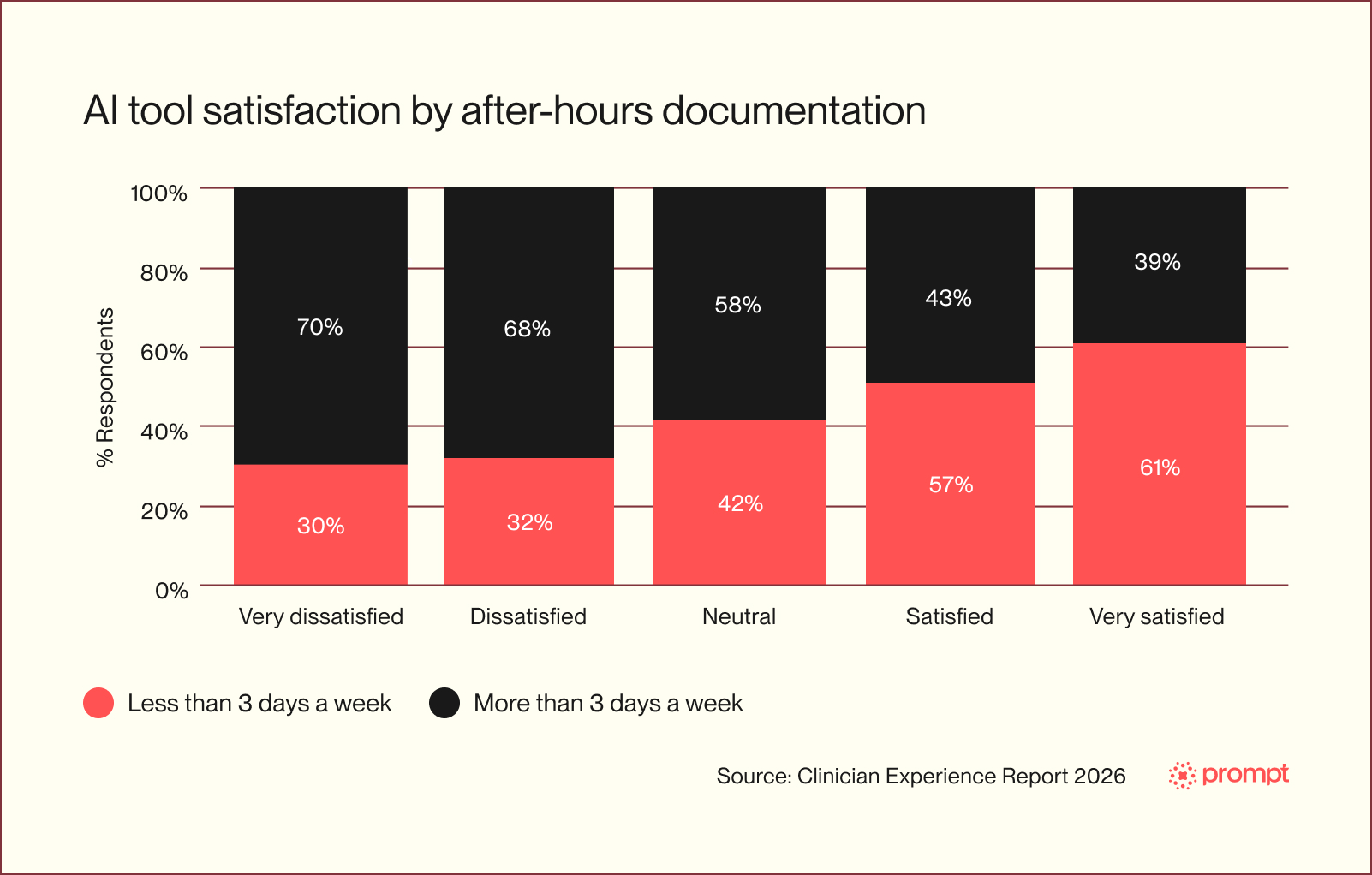
The more clinicians like their AI, the less they document after hours.
What mattered was whether clinicians valued their AI tools
The difference shows up not in whether clinicians use AI, but in how much they value it. The clinicians who are most satisfied with their AI tools take documentation home the least. The ones stuck doing it 5 or more nights a week rate their tools the lowest.
The same pattern holds for how clinicians feel about the whole career.
Clinicians least satisfied with their AI tools are far less likely to recommend the profession. Those most satisfied are far more likely to, and somewhat more likely to plan to stay.
“I believe the use of AI to help with differential diagnosis and appropriate treatments will greatly help our field.”
AI's impact depends less on its presence than its usefulness. Clinicians who value their AI report less after-hours documentation, greater work satisfaction, and stronger confidence in the profession.
What we learned
Throughout the survey, one pattern appeared again and again.
The things that motivate clinicians are remarkably consistent: helping patients, building relationships, seeing progress, and being part of a strong team. Despite years of conversation about burnout, most clinicians still believe in the work itself. More than 75% say the profession has met or exceeded their expectations, and most plan to remain in clinical care.
The challenges clinicians described were also remarkably consistent. Documentation, workload, scheduling pressures, compensation concerns, and administrative demands surfaced across nearly every question. Clinicians are happy with the part of the job they trained for. They are frustrated by the part that surrounds it.
That distinction matters because it points to where practices have the most influence. The survey suggests that clinician motivation actually remains remarkably strong. The opportunity lies in reducing the friction that gradually erodes it.
One of the more surprising findings involved AI. Adoption was widespread, but adoption alone was not associated with less after-hours documentation. Instead, clinicians who were most satisfied with their AI tools spent significantly less time documenting after hours and were more positive about their work overall.
More broadly, the finding reinforces a theme that appeared throughout the survey: clinicians thrive when the systems, workflows, and tools around them reduce friction rather than add to it.
Taken together, the findings tell us that clinicians do not need more reasons to care about patient care. They need fewer obstacles that pull their focus away from it.
That distinction matters because it points to where practices have the most influence. The survey suggests that clinician motivation actually remains remarkably strong. The opportunity lies in reducing the friction that gradually erodes it.
One of the more surprising findings involved AI. Adoption was widespread, but adoption alone was not associated with less after-hours documentation. Instead, clinicians who were most satisfied with their AI tools spent significantly less time documenting after hours and were more positive about their work overall.
More broadly, the finding reinforces a theme that appeared throughout the survey: clinicians thrive when the systems, workflows, and tools around them reduce friction rather than add to it.
Taken together, the findings tell us that clinicians do not need more reasons to care about patient care. They need fewer obstacles that pull their focus away from it.
“Good leadership and a good team is more important than any patient population, documentation load, or compensation.”
How can practice owners respond?
The survey points to 4 ways practices can strengthen the clinician experience: reducing unnecessary friction, protecting clinician time, investing in supportive cultures, and equipping clinicians with tools that genuinely improve their work.
Be strategic with the schedule
Protect after-hours time
Build the culture that keeps people
Give clinicians AI they actually want to use
Need help implementing these?
A note of thanks
Thank you to every clinician who took the time to answer honestly. The picture they painted is encouraging in the places that matter most. People still love this work and still want to do it. The challenges they named are real, but they are the kind a practice can act on. We hope this report helps owners and clinicians have that conversation, and has a positive impact on the industry.
About the survey
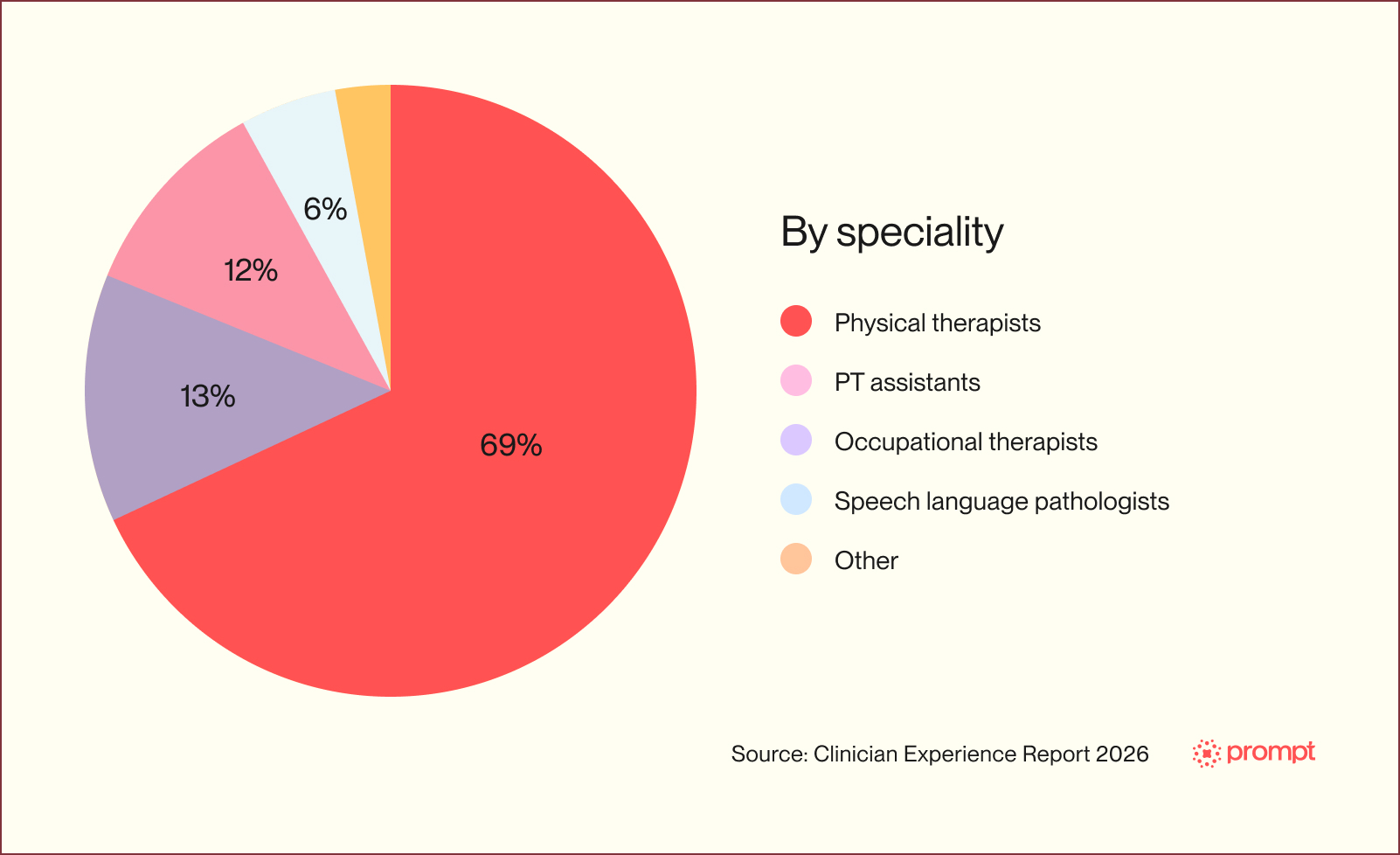
778 rehab therapy professionals completed our Clinician Experience survey in May 2026.
Most were physical therapists (69%), along with physical therapist assistants, occupational therapists, and speech-language pathologists. They ranged from brand-new to more than 20 years in practice.
Most questions let people choose every answer that applied, so those percentages add up to more than 100. Percentages are rounded.
By speciality