The complete guide to choosing physical therapy software
Published on
Last updated on
Is your rehab therapy EMR holding you back? How to know if you need to switch (and what questions to ask vendors)
With 18+ years in the industry, she blends clinical expertise with digital transformation leadership. A board-certified specialist, she built programs at HSS, BetterPT & Ivy Rehab to expand access and quality care.
You're not imagining it: your current physical therapy software (or PT EMR) might be slowing your clinic down.
For most outpatient practices, physical therapy software acts as the operational backbone of the clinic. Your PT EMR doesn’t just store documentation. It manages scheduling, billing, reporting, compliance, and the day-to-day workflows that keep your practice running. When that system works well, your team moves faster and your clinic scales more easily. When it doesn’t, friction shows up everywhere.
How do you choose the best physical therapy software? The complete guide
On paper, your system may feel “fine.” Schedules get filled.Notes get signed. Claims eventually go out the door. But if your team is constantly working around the software instead of with it, small inefficiencies start stacking up. Billing takes longer than it should. Data is hard to trust.Growth feels harder than it used to.
And when your software becomes something you tolerate instead of something that actively helps your clinic run better, it’s worth asking a hard question: Is your PT software holding your practice back?
The stakes are higher than ever: The state of rehab therapy software and practice growth
According to Precedence Research, the global physical therapy software market reached $1.39 billion in 2024 and is projected to grow to $3.82 billion by 2034, a compound annual growth rate (CAGR)of 10.63%. Meanwhile, Mordor Intelligence reports that EMR and documentation systems account for 36.77% of that market, making them the single largest category in rehab technology.
In other words: more software options are entering the market every year. And the decision about which platform runs your clinic is becoming one of the most important choices a practice owner can make.
At the same time, demand for rehabilitation services is accelerating. According to the U.S. Bureau of Labor Statistics, employment of physical therapists is projected to grow 11% from 2024 to 2034, much faster than the average for all occupations, with roughly 13,200openings expected each year. An aging population and rising chronic disease rates are driving more patients into outpatient rehab than ever before.
And outpatient clinics are already carrying most of that demand. Research from Grand View Research shows that outpatient clinics accounted for 50.99% of the U.S. physical therapy services market in 2024, meaning just over half of the industry’s revenue is generated in outpatient settings like yours.
But growth also exposes weaknesses in the systems clinics rely on every day.
Even if your EMR feels “good enough,” operational cracks often show up first in revenue cycle performance. According to a 2024 MGMA report, up to 15% of medical claims across healthcare are denied or delayed, and 60% of medical group leaders reported rising denial rates in 2024. Research also shows that practices relying on disconnected software systems experience higher denial rates than those operating on integrated platforms.
And billing is just one example.
Across healthcare practice management surveys, clinics using fragmented systems report 2–3× more administrative pain points than those running on unified platforms. That shows up as manual work, slower reporting, disconnected data, and staff frustration that quietly drains time and revenue from the business.
The reality is that most clinic owners didn’t choose the wrong system. They chose the one that made sense at the time.
But over the years, what practices need from their software has changed. Clinics today need technology that reduces administrative work, connects workflows across the organization, and helps teams operate faster and smarter.
When that foundation isn’t there, the symptoms are easy to recognize: manual processes, billing delays, lost visibility into performance, and team burnout.
And the longer those problems linger, the harder it becomes for a practice to grow.
What this guide will help you understand
Choosing physical therapy software isn’t just a technology decision, it’s an operational one. The platform running your clinic shapes how efficiently your team works, how quickly you get paid, and how easily your practice can grow.
In this guide, you’ll learn how to evaluate whether your current PT EMR is helping your clinic move forward or quietly holding it back.
Specifically, we’ll walk through:
The hidden operational problems outdated or fragmented systems create
How software decisions impact growth, revenue, and team culture
What modern rehab therapy platforms should actually deliver
The key questions every clinic owner should ask before choosing a new system
By the end, you’ll have a clearer framework for evaluating the software running your practice—and deciding whether it’s truly built for where your clinic is headed next.
The framework we’ll use
This EMR buyer’s guide introduces a practical framework to help you rethink what your software is responsible for inside your clinic.
Rather than focusing on surface-level feature comparisons, we’ll evaluate software across seven categories that consistently determinewhether rehab practices can scale effectively:
Each section ends with a structured checklist of questions you can ask any vendor. These questions are designed to help you systematically evaluate whether a platform truly fits your clinic’s needs and whether it provides a modern, scalable foundation for long-term growth.
First, assess your current physical therapy software
Before you get swept up in software features and sales demos, it's worth pausing to ask: How well do our systems function today?
The most powerful platform on paper means little if your team dreads using it, or if it makes everyday tasks feel heavier than theyshould. Here are 4 fundamental areas to think about when comparing features.
Productivity
Is your software speeding up care delivery, or slowing it down? Research suggests that inefficient documentation workflows can reduce patient-facing time by 30–40%.
How are visit counts tied to your workflow—are they recognized at check-in or after documentation and notes are finalized?
Are your providers spending more time treating or more time charting?
Do team members feel suffocated by clunky workflows?
Economics
What’s the true cost of your current system—not just in dollars, but in efficiency, dropped revenue, admin-to-therapist ratio, and missed opportunities?
Are you regularly afraid of what add-ons will do to your monthly price?
Implementation
How long does training take for new hires?
Is your team still waiting on training, struggling to adapt, or depending on support for basic workflow or template changes?
Complexity
Is the system intuitive or is your team relying on “power users” to hold everything together?
Does it feel like the product was designed for your industry/specialty or just to check a box?
Additional resources for assessing your current physical therapy software and PT EMR (electronic medical record)
From here, we’ll unpack each of the 7 areas that determine whether your software is just functional or truly transformative.
Operational efficiency: How physical therapy management software streamlines work
When evaluating a physical therapy EMR, operational efficiency is often the most visible category, but also the easiest to misjudge.
It's where software demos shine: Slick scheduling views.Smart automations. Impressive workflows. Demos often look great, but once you're in the system, reality sets in.
In practice, too often clinics are left with:
Manual workarounds
Redundant data entry
Communication breakdowns
Teams spending more time managing systems than treating patients
The cost? It's not just time. It's lost margin, morale, and momentum.
Evidence from peer-reviewed clinical studies consistently shows that poorly designed EHR workflows directly reduce face-to-face patient time—a pattern that is well-documented across healthcare specialties including physical therapy. According to the same Annals of Internal Medicine study, which analyzed data from 417 health systems, EHR interaction patterns vary significantly by specialty and platform design.
That's when the bigger question surfaces: Are your 'workflows' the real bottleneck? Research indicates these inefficiencies might not show up in your reports—but they quietly drain your team's energy and capacity every day. According to healthcare operations consultants, workflow bottlenecks are the #1 hidden cost in outpatient rehabilitation practices.
Now imagine a platform that actually supports how your clinic works:
The front desk can schedule, reschedule, or waitlist patients in seconds.
Documentation flows straight into billing with no need for duplicate entry
Tasks are surfaced to the right person at the right time
If that's not your reality, it may be because most platforms weren't initially built to help your clinic run better. They were built to check documentation boxes. A modern rehab therapy operations platform, built on established best practice principles, should do more:
Simplify daily operations
Reduce administrative burden
Make work easier for every role on your team
Ask yourself: Are we spending more time managing the system than moving the clinic forward?
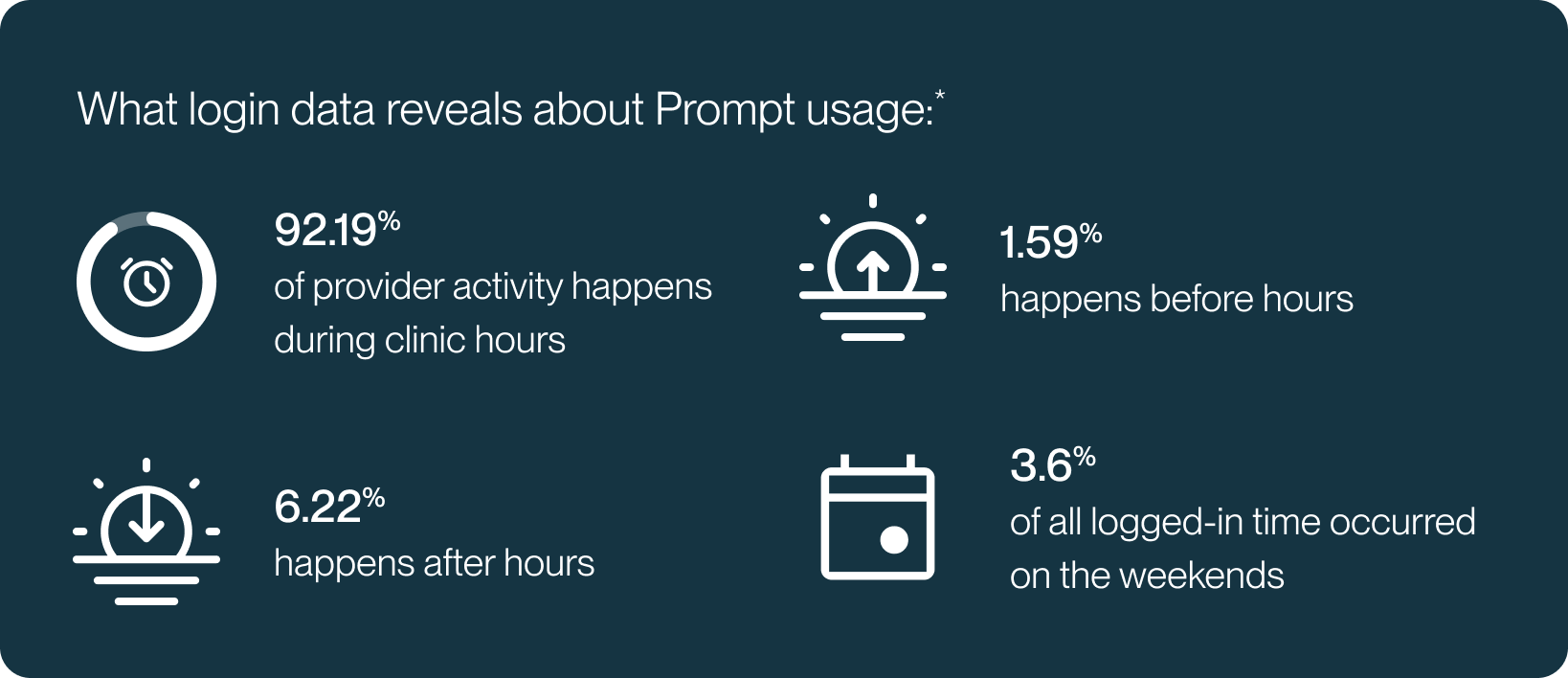
What login data from March 2025 reveals about Prompt usage:
92.19% of provider activity happens during clinic hours
Only 6.22% happens after hours
Just 1.59% happens before hours
And only 3.6% of all logged-in time occurred on weekends
Operational efficiency checklist: Questions to ask when choosing a PT EMR
What tasks are fully automated vs. partially manual?
Can a patient be scheduled, seen, documented, and billed without re-entering the same data?
How are task assignments surfaced to the right team members (e.g. eligibility checks, authorization follow-ups)?
Does the system support automated reminders for underbooked patients or does staff need to track this manually?
How many clicks does it take to reschedule a visit or book out a plan of care?
Can the clinic create unlimited, customizable documentation templates?
Can patients complete self-service intake forms that are customizable by location or visit type?
Are there tools to streamline plan-of-care scheduling (e.g. visual cues or automated recommendations)?
Can front desk, clinicians, and billing work within one unified system or do they rely on separate tools?
Is there a waitlist tool? How manual is the process for pulling patients in?
Does the system eliminate the need for external spreadsheets or tracking tools?
Are patients able to schedule themselves online?
Is there an option for patients to check in via kiosk or mobile device?
Can I filter reports by date, provider, or location?
Can you walk me through how I’d access reports like underbooked patient cases, capacity utilization, units per visit, coding trends, cancellation rates, and visits per discharge?
Additional resources for considering physical therapy practice management efficiency
Practice growth: Your physical therapy EMR should support sustainable scaling
When evaluating PT software, it’s easy to think about growth in terms of size: more clinicians, more locations, more services. But growth doesn’t always mean expansion.
Sometimes it means running more efficiently, hiring with confidence, or finally getting out of survival mode. Regardless of your goals, here’s what you need to think through: is your software helping you grow or are you simply getting by?
What worked for your clinic a few years ago may not support where you're headed now. Even small changes (an additional provider, a new service, a bump in volume) can expose the cracks in systems that weren’t built to flex.
Outpatient rehab continues to grow, and with it, the pressure on clinics to operate efficiently. According to Grand View Research, physical therapy accounted for 39.1% of the outpatient rehabilitation centers market in 2023, meaning PT clinics represent the largest share of outpatient rehab services.
As clinics grow, even small changes like an additional provider, a new service line, or increased patient volume can expose the cracks in systems that weren’t designed to flex.
At the same time, the workforce environment is tightening. APTA workforce projections published in 2025 estimate the profession faced a shortfall of roughly 12,070 physical therapist FTEs as of 2022, a gap expected to persist through 2037 even as demand grows 14.7%. Similarly, the U.S. Bureau of Labor Statistics projects about 13,200 physical therapist openings each year through 2034.
In practical terms, clinics are competing for a limited pool of clinicians while trying to serve more patients.
When hiring is difficult, maximizing the productivity of your existing team becomes critical. Making systems that streamline workflows and reduce administrative burden far more than a convenience. They become a necessity.
And it’s not just legacy tools that fall short. Some newer platforms are built on shallow foundations—rushed to market, optimized for demos, or for entirely different healthcare specialties. They’re often:
Optimized for their own margins, not long-term fit
Priced to look appealing but with tradeoffs like thoughtful workflows, real support, and innovation.
Built around short-term financial benchmarks, not long-term outcomes
Instead, look for a partner that prioritizes sustainable impact for both providers and patients.
You know that running and growing a practice takes more than great clinical care. It takes coordination, visibility, and infrastructure that supports every role on your team. Your software should reflect that. The right platform doesn’t just document visits, it helps you operate like a business that’s built to grow.
Ask yourself: Is our software supporting the next phase of growth for our practice or silently holding it back?
Practice growth checklist: Questions to ask vendors
What happens to workflows as we scale. Do they break, duplicate, or evolve?
How long does it take new staff to learn the system? Can new users be onboarded without a steep learning curve or hours of support tickets?
Are permissions, roles, and settings manageable across a growing team?
Can you share case studies of practices my size?
Is growth limited by your licensing model or backend architecture?
How does the system support multi-location operations and reporting?
What staff member per clinician ratio does your system support?
Do you have reports on the growth metrics your customers have achieved?
What’s the transition process like when switching to your software? Is there any downtime?
What is the cost to add non-clinical users? Admin, billers, students, etc.?
How can you help me fill my hiring pipeline?
Additional resources for assessing if a physical therapy EMR supports practice growth
Onboarding & support: A PT EMR (and the team behind it) should feel like a true partner
When you invest in physical therapy software, you're not just buying a platform: you’re choosing a partner.
You shouldn’t have to brace for impact. Support isn’t just for when something breaks. It starts the moment you decide to switch platforms and it should give you the confidence that you’ll come out stronger on the other side.
Many practices fear that switching software will mean weeks of lost productivity, billing delays, and team burnout. Healthcare IT experts at Medical Economics report that it can take anywhere from one month to six months before a practice returns to full productivity after an EMR switch.According to EMR Guides, provider training alone averages 23.9 hours per clinician, with administrative staff requiring an additional 10–15 hours each.
And in some systems, that's exactly what happens. But onboarding shouldn't feel like a gamble. With the right partner, your team isn't left to fend for themselves—they're guided by experts who know how to help you stay productive through the transition.
Here’s what to look for in onboarding and support:
Responsiveness: Do you get answers quickly, or do tickets linger for days?
Expertise: Are you talking to people who actually understand and bring clinical experience to the conversation? Or are they just reading scripted replies?
Proactivity: Does your vendor help you optimize workflows, catch problems before they snowball, and share best practices as you grow?
Stability: Does their onboarding process protect revenue and productivity, or put them at risk? Research shows that structured onboarding programs reduce time-to-productivity by up to 50%.
Many vendors treat support as an afterthought; something outsourced overseas or staffed with generalists. You deserve better.
Now, imagine onboarding and support that feels like an extension of your business.
A proven onboarding process designed to protect productivity and cash flow, not pause it
A dedicated team of experts, including a Customer Success Manager, a Billing Success Manager, and EDI specialists
People who’ve actually been in your shoes; former clinicians, billers, and rehab therapy operators
100% U.S.-based teams invested in your long-term success
Ask yourself: If something goes wrong tomorrow, do you trust your software partner to have your back?
Onboarding & support checklist: Questions to ask vendors when choosing a PT EMR
What does onboarding look like for new users and how long does it take?
What’s your approach to preserving productivity and revenue during the transition?
Are we assigned a dedicated Customer Success Manager and billing support contact?
Are the CSMs licensed clinicians? Are the BSMs certified billers?
Is your support team U.S.-based or offshore?
What are your average response and resolution times for support tickets?
Can you share examples of how your team proactively helps practices improve workflows?
Are your support staff trained in outpatient rehab workflows (billing, scheduling, documentation)?
How do you gather customer feedback and how is it incorporated into product improvements?
What resources or training materials are available to help our team learn and troubleshoot independently?
Can I speak with references who’ve worked with your support team?
If we experience an urgent issue during clinic hours, how quickly can we expect live help?
Additional resources for choosing a PT EMR with reliable support and training
Billing & RCM: A PT EMR with truly integrated billing should prevent revenue loss
Revenue problems rarely start in the billing department. They start upstream, with slow scheduling, inconsistent documentation, unclear tasking, and software that isn’t designed to surface issues until it’s too late.
It’s not uncommon to see clinics chasing denials, reworking claims, and manually cleaning up what the system should’ve caught in the first place. According to revenue cycle specialists, the average practice spends 10–15 staff hours per week on denial management time that could be redirected to patient care. Research finds that automated claim scrubbing can reduce this burden by 60–80%. But here’s what you need to think through: how much of that financial drag is really a billing problem and how much of it is a software problem?
Even if you’ve built a strong internal team or outsourced your RCM, your platform may be quietly working against them. If it’s hard to:
Track a claim in real time
Figure out workarounds and modifier issues
Understand your data without having to download it
Know why reimbursement is slipping
That’s not a billing issue. It’s a visibility issue.
And just like with growth, poor software architecture is often the culprit. Whether it’s a legacy platform that hasn’t kept up or a newer tool that’s not built to go deep, you can’t fix revenue gaps with shallow systems.
In a better system:
Denials, appeals, and reconciliation are automated, not managed manually
Your billing team (or RCM partner) sees missing charges and payer requirements in real time
Claims are created from clean, complete documentation
Payer rules are built in
Tasks are auto-assigned
Nothing slips through the cracks
A truly integrated PT EMR and billing platform actually prevents problems rather than just reacting to them. Revenue cycle management experts and industry standard methodology consistently recommend that practices select systems where documentation, scheduling, and billing are natively connected eliminating the manual handoffs where errors and revenue leakage typically occur. That kind of intelligence isn't a billing "feature."It's the foundation of a financially healthy practice. The best physical therapy EMRs connect documentation, scheduling, and RCM into one seamless workflow.
Ask yourself: is our software helping us stay ahead of revenue risk or just clean up after it?
Billing checklist: Questions to ask vendors
Can our team (or RCM partner) view billing performance in real time?
How long does it take to get paid?
What tools are in place to reduce denials and automate appeals?
Does the system surface missing charges, incomplete notes, or payer-specific errors before claims go out?
How easily can we track unresolved claims and monitor financial KPIs?
Does the system support both in-house and outsourced billing workflows without duplicate work?
Do you offer RCM services? If yes, where is your team based?
How have you built AI and automations into your billing platform to support my success?
How quickly does your team respond when I need billing support? Are they certified billers? U.S.-based?
Additional resources for evaluating integrated PT EMR and billing software
Contracts: What to know when choosing physical therapy software vendors
Contracts aren’t the problem. In fact, they’re standard in this space and often necessary to support onboarding, support teams, and platform stability.
But not all contracts are created equal, and the terms you agree to can shape your clinic’s experience long after the ink dries.
When evaluating a software partner, don’t just look at the feature set. Look at the foundation of the partnership.
Do the terms of my contract allow me to grow how I want?
Is the product stable, or known for outages and service delays?
Does the company have a clear track record of innovation?
Is this company future-proofed? Look at their extensibility, scalability, provenance, maturity, support, and reliability
It’s also worth asking: who’s really behind the product? Healthcare industry analysts and established vendor evaluation frameworks recommend examining ownership structures carefully. Some vendors are backed by private equity firms focused on margins more than mission. That doesn't make them wrong, but it should make you more curious. What does their funding structure mean for product strategy, service prioritization, support, and long-term sustainability? Research indicates that PE-backed healthcare software companies invest 15–30% less in R&D than founder-led companies.
A strong contract isn’t just about legal terms. It’s about alignment.
Remember, you’re not just choosing software, you’re choosing a partner. One that should empower your team, support your goals, and evolve with your clinic, not hold it back.
Ask yourself: Will this company and platform still be what we need 2 years from now or will we outgrow it before the contract ends?
Contracts checklist: Questions to ask when choosing a physical therapy EMR
Are we locked in for 3+ years?
How often do customers renew vs. leave early?
Is there flexibility in the contract that allows me to grow or evolve how I want to?
How long is the initial term and what are the renewal terms?
Are there hidden fees tied to usage, users, or reporting access?
What happens to our data if we decide to switch systems in the future?
Do you offer a contract buyout with my current system?
If I add on another product, how does that change the terms of my contract?
Additional resources for navigating physical therapy software contracts and vendor comparisons
Clinic culture: How thoughtfully-designed physical therapy management software impacts staff and patients
Software might not show up in your clinic’s mission statement but it shows up everywhere else.
It’s in how your team communicates, how much work they bring home, how clinicians feel at the end of a 10-hour day, and in whether people stay or quietly burn out.
When evaluating physical therapy practice management software, ask: how does this system affect the way my people work and feel?
The clinical evidence and peer-reviewed research on therapist wellbeing is alarming, and it underscores why software selection is fundamentally a workforce strategy decision. According to a peer-reviewed study reviewed by the American Physical Therapy Association (APTA), nearly 50% of physical therapists surveyed reported experiencing burnout, a rate that rehabilitation leaders consider unsustainable. The Federation of State Boards of Physical Therapy (FSBPT) published research noting that EMR systems do not decrease workload and may decrease clinician autonomy, directly contributing to burnout when poorly designed. According to the National Association of Rehabilitation Agencies (NARA), approximately 22,032 physical therapists left the workforce in 2021 alone, making retention through better tools a critical priority.
Simply put, when tools are clunky, disconnected, or hard to learn, your team feels it. According to a survey by the National Academy of Medicine, technology-related frustration is a leading contributor to healthcare worker burnout. It looks like:
Clinicians falling behind and spending more time clicking than treating
Front desk staff relying on manual workarounds
Billing teams chasing tasks that never should’ve slipped through the cracks
New teammates immediately feeling overwhelmed by software onboarding
The result? Fatigue, frustration, and a culture built around coping, not thriving. Culture isn't built in off sites or events. Research demonstrates it's built (or broken) in the tools people use every day. Per organizational psychology studies, workplace technology is now one of the top 3factors in employee satisfaction.
The patient side is equally concerning. Clinical research consistently shows high attrition rates in physical therapy. Research published in the Journal of Orthopaedic & Sports Physical Therapy (JOSPT) has identified multiple factors associated with patient self-discharge, emphasizing that technology-driven engagement strategies can significantly improve attendance and plan-of-care completion. Software that lacks automated reminders, self-scheduling, and predictive analytics for at-risk patients contributes directly to these dropout rates—and the associated revenue loss.
Ask yourself: if your team had to rate your culture based on your EMR today, what would they say?
Red flags of burnout
Team Member
Symptoms
Root Cause
Clinician
Late notes, after-hours work
Poor documentation UX, no smart templates or AI
Front Desk
Missed appointments, rescheduling chaos
No waitlist automation, clunky calendar, manual rescheduling
Billers
Denials, delays, unclear errors
Lack of visibility into claim flow or payer rules
Owner
Can’t forecast, unclear on practice health
No actionable insights, unreliable reporting
Patient
Missed visits, dropped plans of care, unpaid balances
No self-scheduling, no portal, outdated communication tools
Culture Checklist: Questions to ask PT EMR vendors
Who’s responsible for onboarding and how is success measured?
How can I ensure your team is plugged into the industry?
How quickly can support resolve common issues?
Is your support team on- or off-shore?
What’s your process for collecting and acting on user feedback?
When was the company founded?
Who makes product roadmap decisions?
Can I meet some members of the success team?
How do you consider, weigh, and implement product decisions based on customer feedback?
What is your company mission?
Additional resources for considering how physical therapy scheduling software impacts clinic culture
Technology and AI: Why all-in-one PT software with automation future-proofs your clinic
If you’re hesitant about AI, you’re not alone. For many rehab therapy teams, the idea of AI can feel uncertain: too expensive, too complex, or too far removed from the patient-centered work you do every day.
But AI in rehab therapy doesn't have to be futuristic or overwhelming. The clinical evidence is increasingly clear that AI adoption in healthcare is rapidly accelerating. According to the American Medical Association's 2024 physician survey, cutting administrative burdens is now physicians' top anticipated use for AI, with significant gains in positive sentiment between 2023 and 2024. A Kaiser Permanente analysis found thatAI-assisted note-taking saved nearly 16,000 hours of documentation time in the first 15 months of rollout. A UCLA Health randomized controlled trial (published 2025) demonstrated that AI scribes measurably reduce documentation time and improve physician well-being.
AI scribe tools: Transcribe or summarize notes during or after a visit.
Predictive & prescriptive AI: Flags potential no-shows, missed plans of care, or incomplete documentation. Helps staff take action before things go off course.
Automated workflows: AI-powered logic that auto-assigns tasks, flags missing charges, or prioritizes next steps. Removes the need for spreadsheets or manual tracking.
AI for intake & patient experience: Gathers relevant info before a visit and customizes forms based on context—making onboarding faster and more meaningful for both patients and staff.
When it’s thoughtfully designed, AI is just smart automation. It blends into your daily workflows, helps your team go from reactive to proactive, and catches things before they slip through the cracks.
But not all platforms are built to support that kind of intelligence. A lot of software in the rehab space looks sleek on the surface, but dig a little deeper and you'll find a patchwork of bolted-on modules, third-party plug-ins, and fragile one-way integrations built on outdated architecture: a recipe for prolonged downtime during any outages. There's a demonstrated difference between a modern platform and a modern-looking one.
Here's how to tell the difference when it comes to AI: If an AI scribe exists only to take notes, it's likely just a surface-level feature, added for the appearance of innovation rather than real impact. In contrast, a truly intelligent scribe is deeply integrated into the clinic's workflow. It doesn't stop at documentation; it also understands the clinical context, surfacing relevant past notes, generating real-time case summaries, suggesting CPT codes, and adapting to each provider's style over time. That's the difference between an AI feature that checks a box and one that actually improves how providers work.
Helpful AI shouldn't replace your team or get in the way of patient care. It should amplify your team's skills and give them time back. As researchers at PMC/National Institutes of Health have documented, health systems that strategically adopt AI tools report measurable improvements in operational efficiency, clinician satisfaction, and documentation quality. The key, according to healthcare technology experts, is selecting platforms whereAI is natively integrated into clinical workflows rather than bolted on as an afterthought, a best practice that has been verified across multiple healthcare settings.
Ask yourself: Is this platform truly built for the future or just branded like it is?
Technology & AI checklist: Questions to ask vendors when choosing a PT EMR
Is this a unified platform with proprietary AI or a combination of acquired tools and plug-ins?
Where is AI currently embedded and what tasks does it actually automate?
Is all AI HIPAA compliant?
Do you use AI and automation to keep schedules full?
Does the AI ask dynamic questions to personalize intake and surface relevant patient insights?
Does AI assist in note taking?
Does AI assist in code compliance?
Can you show me a live demo of the AI features?
How does the system use data to support decision-making in real time?
What kind of documentation or predictions does the AI handle today (not just “coming soon”)?
What are your policies around AI privacy, patient data use, and transparency?
Do you have your own AI Engineering and AI Ethics Team?
Additional resources for assessing all-in-one PT software with AI and automation
Now that you’ve evaluated what really matters (across operations, growth, support, billing, contracts, culture, and technology) it’s time to take a step back and look at the bigger picture.
“Upgrading your EMR” isn’t the goal here. Building a modern, scalable clinic foundation is. And that starts with rethinking what your software should actually do.
Most clinics find themselves on 1 of 3 paths when it comes to their software setup:
The Simple Stack
These platforms promise ease and simplicity and if you're just getting started, that might feel like enough. They're often visually clean, low cost, easy to set up, and handle the basics like scheduling, documentation, and maybe billing. The problem? These platforms lack the automation, infrastructure, and flexibility to support a growing clinic. They often market themselves as cheaper alternatives to more advanced platforms but fall short when it truly matters. When your schedule becomes more complex, you add another provider, or you need to understand why you're falling behind or reimbursement is dipping, you'll find yourself in a difficult position. The simplicity that once felt like a win starts to feel like a wall: manual processes, limited reporting, inadequate support, and scattered work arounds that staff are forced to create. Ultimately, these platforms weren't designed to grow with your practice, and your team will spend more time managing tools than managing your clinic.
The Frankenstack
You bought into the idea of an "all-in-one" platform, but under the surface, it's really a collection of disconnected tools stitched together over time. Each module feels slightly different. Data doesn't flow cleanly. Downloading reports just to reupload them feels like a constant.Features that were promised don't fully deliver.
Ultimately, the user experience in this path isn't much better than the simple one. Sure you have more tools, but more doesn't equal better. Often, it's just more cumbersome. It might feel grown-up and look modern from the outside, but it still creates the same inefficiencies and frustrations you thought you were escaping. And the larger you grow, the more those cracks (like disjointed workflows, slow documentation, piles of manual spreadsheets, and duplicative tasks) start to widen, right when you need everything to work together most.
The Comprehensive Platform
This path is rare and intentional. A true platform designed from day one to support modern rehab therapy across every team, workflow, and growth milestone.
It’s not just all-in-one, it’s unified. Documentation flows into billing. Scheduling connects with reporting. AI anticipates your future needs and helps you stay one step ahead—rather than simply summarizing what has already happened. Support isn’t an afterthought but a core part of the company. Even better, they are industry veterans who know exactly where you’re coming from, all US-based and dedicated to your clinic’s long-term success.
Whether you're opening a new location, onboarding staff, or launching a new service line, this path flexes with you. Check platforms like G2 and Facebook groups for raving fans. This is the type of company whose customers can’t stop saying how amazing it is to get their lives back.
Category
Simple Stack
Frankenstack
Comprehensive platform
Operational Efficiency
Minimal automation
Redundant workflows
Unified, automated workflows
Growth Support
Limited flexibility
Breaks at scale
Built to evolve with clinic
Billing & RCM
Basic tools only
Disconnected, reactive
Integrated, proactive
Contracts
Short terms, limited features
Long terms, rigid
Flexible, partnership-focused
Culture Impact
Team fatigue
Burdened by manual processes
Empowered, aligned teams. Very little work taken home
Tech & AI
Looks modern
Bolted-on modules
Native, scalable intelligence
Meet Prompt Health
Prompt Health isn’t just an EMR. It’s the rehab therapy operations platform powering the next generation of outpatient rehab clinics.
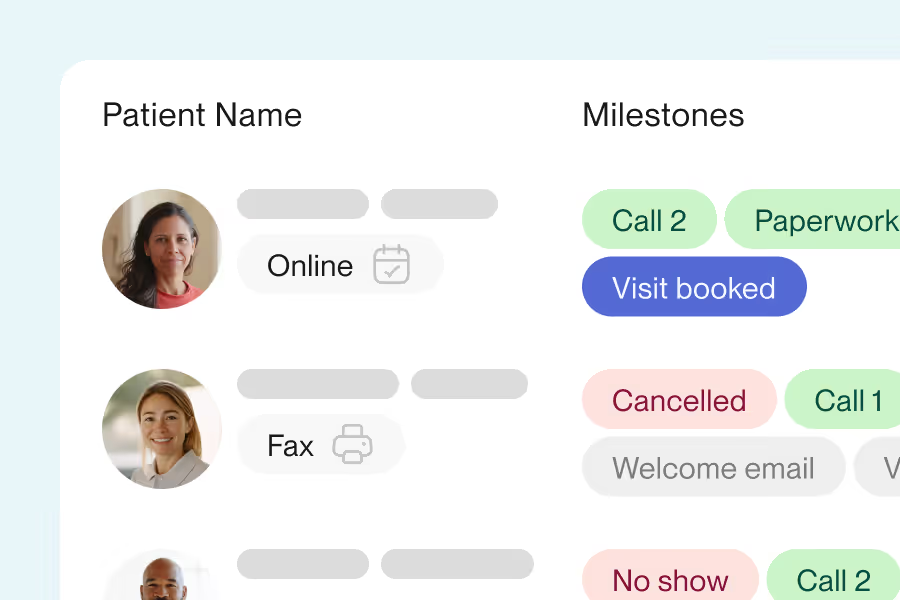
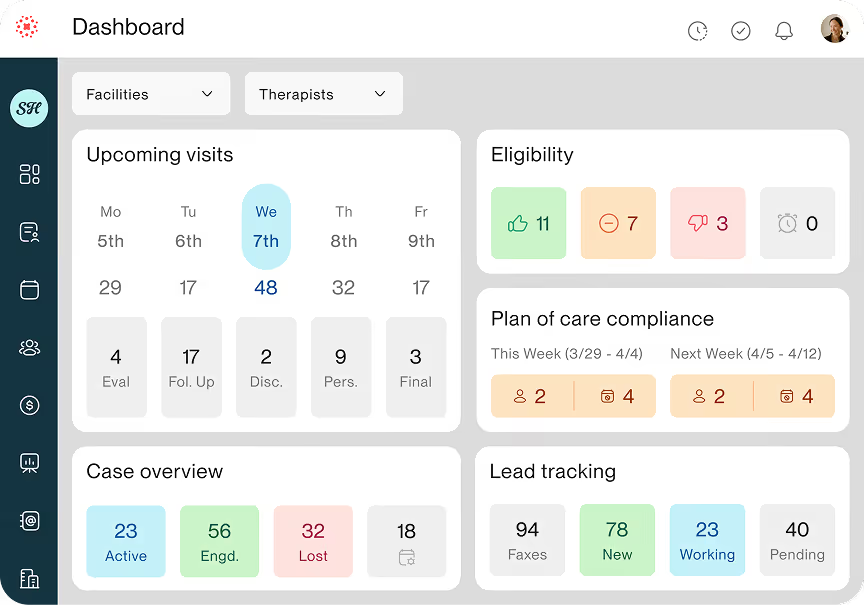
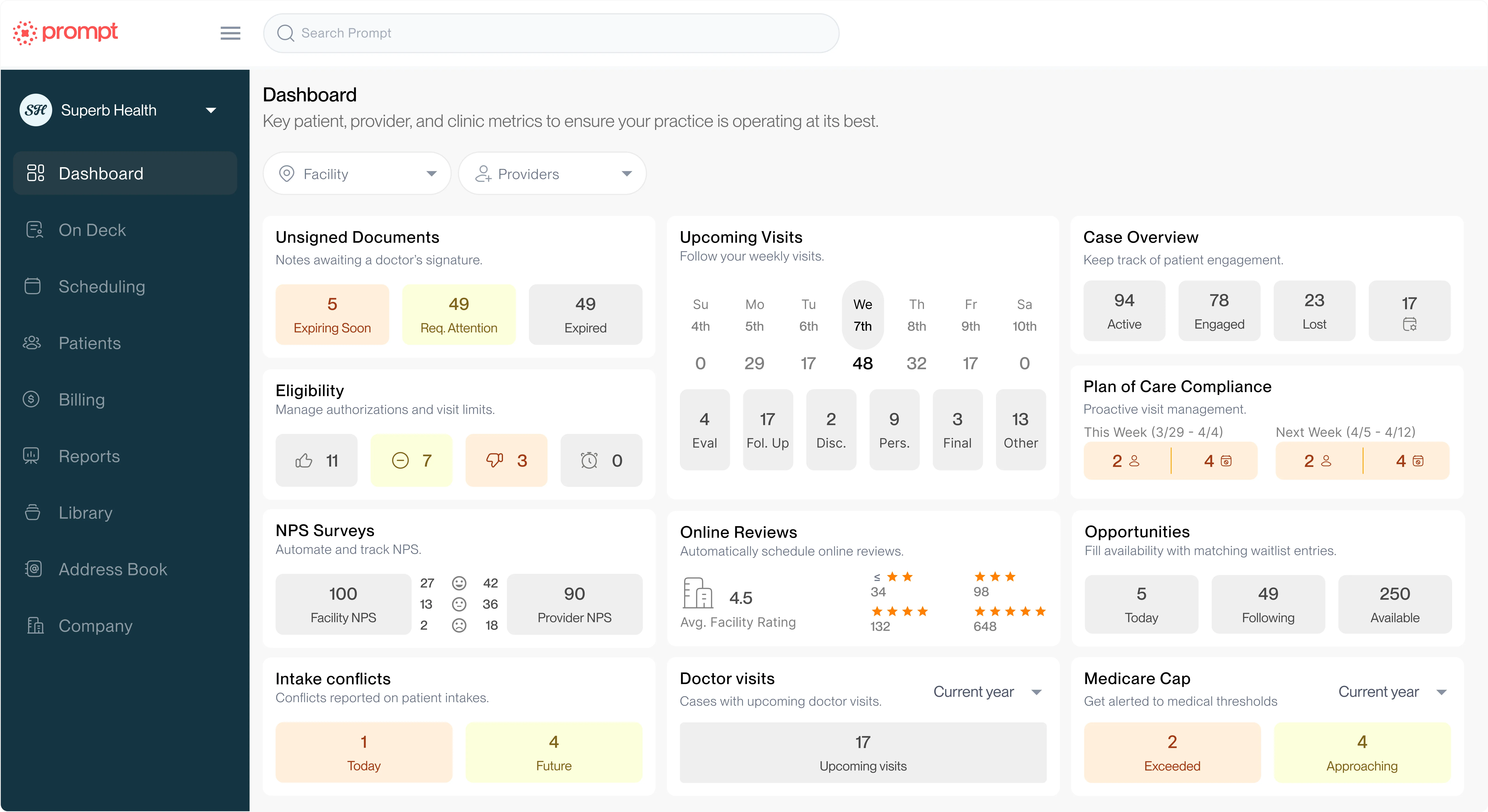
Built from the ground up to streamline every part of your business, Prompt replaces the patchwork of disconnected tools with a single, modern operating system for patient care, scheduling, documentation, billing, compensation, and patient engagement. Every workflow is integrated. Every insight is real time. Every click supports your team in delivering better, faster, more consistent care.
And with AI thoughtfully embedded across the platform, Prompt helps you stay ahead of the work, not buried in it. From no-show predictions and smart documentation tools to billing automation and patient communication, it’s intelligence that lightens the load for your team and creates a smoother, more connected experience for your patients.
Prompt offers:
A smart, secure, and compliant EMR that simplifies documentation and scales with your clinic
AI and automations that reduce busywork and deepen patient relationships—without adding headcount
Revenue cycle management (RCM) tools that streamline billing workflows and accelerate payments
A dedicated, U.S.-based support team full of clinicians, billers, and rehab experts
Self-service kiosk and intake for a seamless, modern patient experience
Flexible compensation tools that help rehab professionals earn more without burning out
RTM and engagement solutions designed specifically for outpatient rehab therapy
Whether you’re a single-site practice or scaling across multiple locations, Prompt gives you the foundation to operate efficiently, grow sustainably, and keep your focus where it belongs—on the people and patients you care for. It was built by a team of business and software experts to improve efficiency for every user in the clinic and help you increase profits.
If your current system is helping you get by, Prompt is here to help you go further.
What is the best EMR for physical therapy clinics?
The best physical therapy EMR depends on your clinic's size, growth plans, and operational needs. According to a report from Grand View Research, the PT software market was valued at $1.25 billion in 2023, offering dozens of options. Per industry analysts, the top-rated platforms score highest in documentation efficiency, billing integration, and customer support quality. The strongest platforms combine documentation, scheduling, billing, and patient engagement in a single unified system rather than bolting together separate tools. Look for native AI capabilities, integrated RCM, and a dedicated, U.S.-based support team with clinical expertise. Practices that prioritize a comprehensive, unified platform over a simple or "Frankenstack" approach typically see better long-term outcomes in efficiency, revenue, and staff satisfaction.
How much does physical therapy software cost?
PT EMR pricing varies widely based on features, number of providers, and contract terms. Most platforms charge per provider per month, with costs ranging from $50 to $500+ depending on functionality. Be wary of low sticker prices that require expensive add-ons for billing, reporting, or patient engagement features. The true cost of your software includes not just the subscription fee but also implementation time, training hours, lost productivity during transition, and revenue impact from claim denials or scheduling inefficiencies. Always ask vendors for a total cost of ownership breakdown. According to healthcare IT consultants, a comprehensive TCO analysis should cover a minimum 3-year horizon.
How long does it take to switch physical therapy EMR systems?
According to Medical Economics, transitioning to a new EMR can take 1-6 months before a practice reaches full productivity. However, the timeline varies significantly by vendor. Some platforms, like Prompt, offer structured onboarding processes with dedicated implementation teams that minimize disruption. Key factors that affect transition time include data migration complexity, staff training requirements, and whether your billing workflows can run in parallel during the switch. The best vendors assign a dedicated Customer Success Manager and protect your cash flow throughout the process.
What should I look for in PT billing and RCM software?
With initial claim denial rates reaching 11.8% in 2024 according to industry data, your billing platform needs to prevent problems—not just process claims. Look for real-time claim tracking, automated denial management and appeals, built-in payer rules, and proactive alerts for missing charges or documentation gaps. The best PT billing systems are natively integrated with documentation and scheduling—so claims are generated from clean, complete data without manual re-entry.
How does AI improve physical therapy documentation and workflows?
AI in physical therapy is advancing rapidly. According to the American Medical Association, reducing administrative burden is now clinicians' top anticipated benefit from AI. In practice, AI-powered PT platforms can automate note generation, suggest accurate CPT codes, predict patient no-shows, flag incomplete documentation, and personalize intake questionnaires. A study from the Journal of the American Medical Informatics Association (JAMIA) confirms that AI scribe utilization shows measurable impact on documentation time across healthcare settings. Kaiser Permanente reported saving nearly 16,000 documentation hours in the first 15 months of AI scribe deployment. The key differentiator—a benchmark that separates industry-leading platforms and practices from the rest—is whether AI is deeply integrated into workflows or just a surface-level add-on.
Why is patient retention so low in physical therapy, and how can software help?
Research consistently shows that approximately 20% of physical therapy patients drop out within the first three visits. Modern PT software combats this with proven engagement tools: automated appointment reminders, self-scheduling portals, waitlist management, and predictive analytics that systematically flag at-risk patients before they disengage. Platforms with integrated patient engagement tools help clinics retain more patients, improve outcomes, and protect revenue.
Subscribe for updates
Get practice growth tips delivered right to your inbox
Thank you! Your submission has been received!
Oops! Something went wrong while submitting the form.
By submitting your information, you agree to Prompt's Privacy Policy. You can opt out anytime.






.png)
.webp)