If there's one thing we've learned from talking to chiropractors, it's that they care deeply about patient outcomes. But as practices grow, it's not usually clinical skill that becomes the bottleneck: it's operations.
Across hundreds of conversations, chiropractors have told us the same story: Their days are consumed by disconnected systems, manual work, documentation anxiety, unpredictable schedules, and revenue they suspect they're losing but can't easily see.
According to the American Chiropractic Association (ACA), there are approximately 70,000 licensed chiropractors in the United States treating more than 35 million patients annually. That's a profession with enormous clinical impact, and yet the operational tools available to most practices haven't kept pace. A survey from Chiropractic Economics (2025) found that while chiropractic revenue is growing, overhead management remains a persistent challenge for practice owners.
Technology is supposed to support the business of care. But too often, it quietly adds risk, friction, and burnout instead.
What are the top 5 problems Prompt solves for chiropractors? A quick breakdown
That's why we entered the chiropractic market the same way we built our foundation in physical therapy: by listening first, building alongside operators, and committing to long-term partnership, not just surface-level features.
As Mike Dwyer, Prompt's Co-founder, puts it: "Our goal is to give chiropractors a platform they actually love, technology that makes their work easier, their practice financially stronger, and their patients healthier."
The result is a fully unified, AI-powered platform built for modern chiropractic practices. Here are the 5 biggest challenges chiropractors tell us disappear after switching to Prompt.
1. Fragmented workflows and manual work that burns out staff
For most chiropractic practices, the real problem isn't too many tools. It's the hidden human cost of trying to run a clinic on disconnected systems. A peer-reviewed study published in Health Affairs demonstrated that the average physician spends 8.7 hours per week, roughly 16.6% of total working hours, on administration alone. In a small chiropractic practice, that administrative time competes directly with patient care and revenue.
Scheduling lives in one place. Notes in another. Billing somewhere else. Communication happens over email, text, sticky notes, or memory. Staff duplicate work. Owners become the glue. And when one key person is out, the whole clinic feels disorganized.
According to the American Medical Association (AMA), physicians reported spending 7.9 hours per week on administrative tasks in 2023 (broader healthcare, not chiropractic-specific). For chiropractic practice owners running fragmented systems, that number is likely even higher because the burden falls on a smaller team.
This shows up as nights and weekends spent verifying basics instead of growing the business. Practices depend on heroics instead of systems.
Dr. Scott Bremer, DC, described what this looked like before Prompt. "I used to have 3-hour sessions after the workday on Thursday to review the week of what was done, what wasn't done, what's being billed properly, what wasn't," he says.
How Prompt solves fragmented workflows
Prompt eliminates this operational drag by replacing patchwork workflows with one unified system. Here's what that looks like in practice:
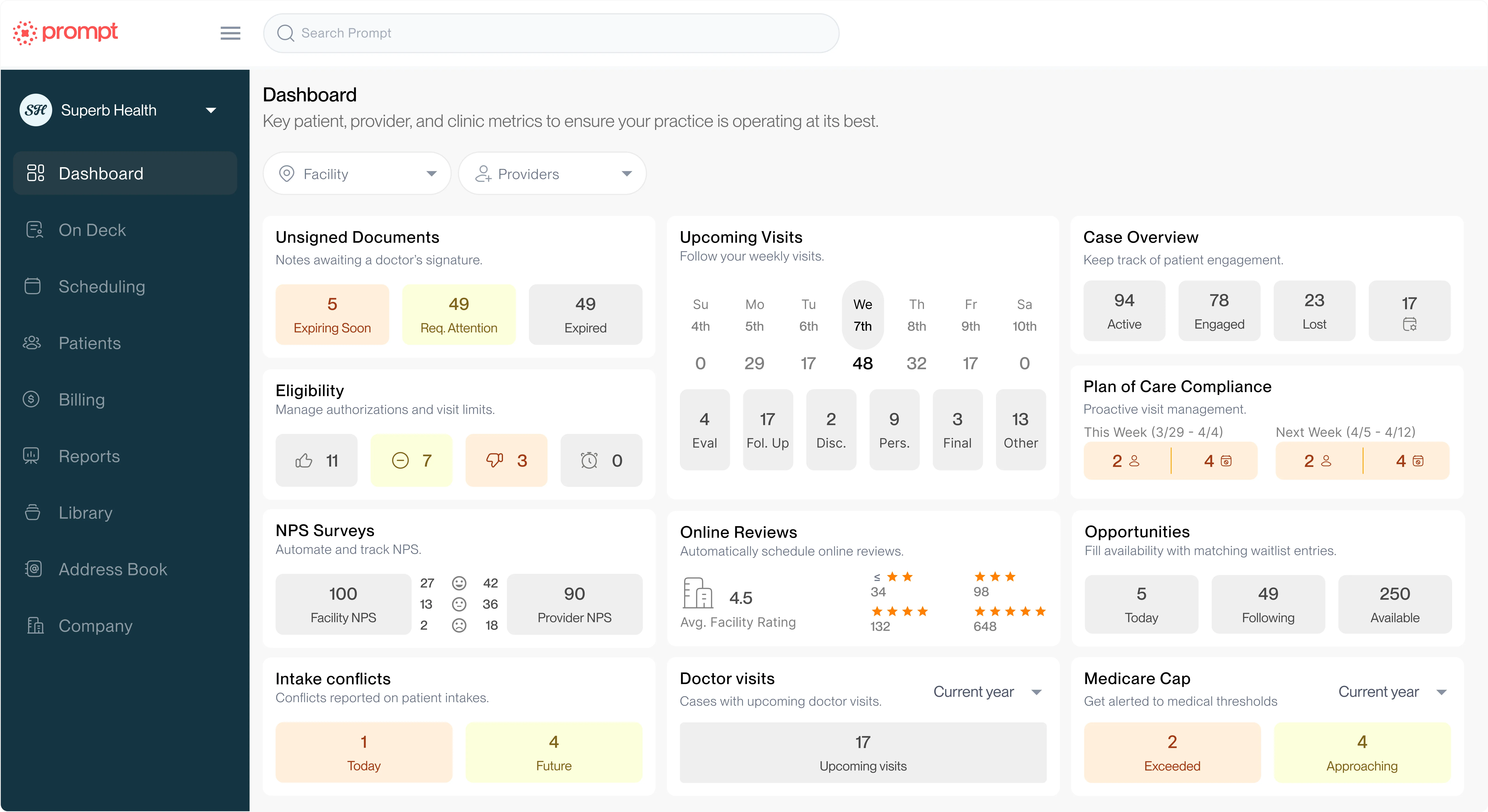
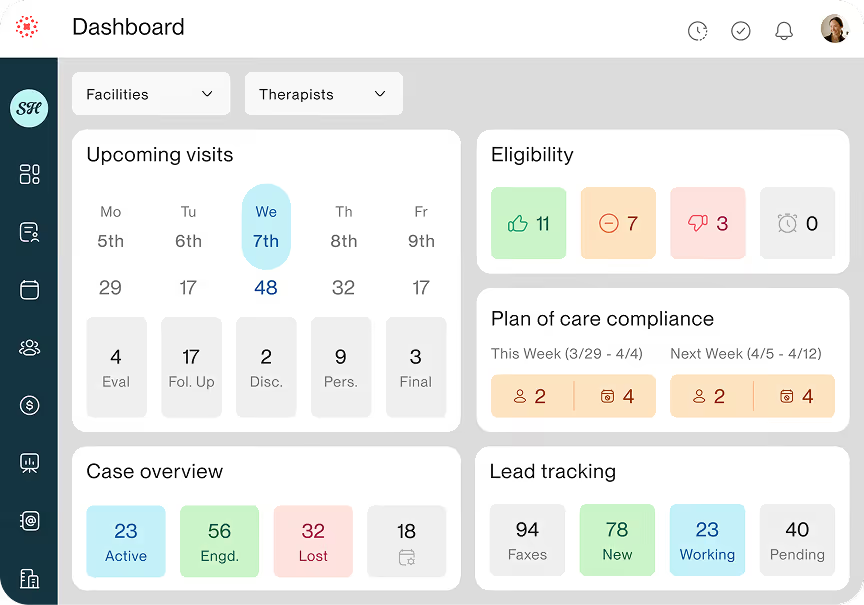
- Scheduling, documentation, billing, communication, and collections all live in one platform, visible in real time across providers and locations
- Shared dashboards and role-based permissions mean owners no longer have to manually check work or act as the connective tissue between systems
- Billers and clinicians work on the same note, and collections flow back into the EHR automatically
- AI surfaces what needs attention without relying on memory, follow-ups, or after-hours reviews
"The fact I can hit just one section and it's all there is incredible to me," Dr. Scott says. "What a big difference that has made for me."
2. Systems that work early but fail as practices scale
Even with great staff, many systems simply can't be trusted to scale. Server-based crashes, slow performance, broken integrations, and fear of migration don't matter much in a solo practice. They become existential risks once a practice adds volume, locations, or multiple disciplines.
Data from the 2025 CAQH Index shows that healthcare has avoided $258 billion in administrative costs through automation and electronic transactions, which means practices still relying on manual or disconnected systems are falling further behind the industry benchmark.
According to the NBCE 2025 Practice Analysis, 49% of chiropractors are solo practitioners, while 36% work in multi-doctor offices and 12% practice in multidisciplinary or integrated health facilities. In practical terms, that means nearly half the profession is already operating in settings where system reliability directly affects multiple providers, staff, and patient workflows.
How Prompt is built to scale
In practice, Prompt is built as infrastructure, not a bundle of features:
- Cloud-based architecture eliminates server crashes and local performance issues
- Unified data model means scheduling, notes, billing, and reporting all speak the same language, which is the established best practice for multi-location healthcare platforms
- No double entry and no fragile integrations holding the business together
- Multi-location visibility from a single platform, so growth doesn't create operational chaos
That trust changes how owners think about growth. "I don't know if I would ever even attempt another company of this size with this many locations with different software," Dr. Scott says. "The oversight is the hardest part."
Prompt's AI only works because the foundation is reliable. AI doesn't patch over broken systems. It amplifies unified ones. That's why clinics often describe Prompt as what they graduate into once growth breaks their legacy tools.
3. Documentation and compliance risk across the full course of care
For chiropractors, documentation anxiety isn't about typing faster. It's about whether notes hold up over time, across re-exams, care plans, and payer scrutiny.
Copy-paste documentation is one of the fastest paths to denials and audits, but many chiropractors don't realize the risk until revenue is already leaking. Report data from the AAPC (American Academy of Professional Coders) confirms that payers and contract auditors actively look for contradictions and cloned notes, and that even unintentional errors from copy-paste workflows can trigger medical necessity denials. The Office of Inspector General (OIG) has specifically flagged copy-and-paste as the most common documentation error in EHR systems, noting that it leads to improper payments, inaccurate records, and patient safety risks.
How Prompt reduces documentation risk
The clinical evidence is clear: documentation quality directly affects reimbursement and compliance outcomes. Prompt reframes documentation as risk reduction, not speed:
- AI scribing and smart rewrite tools create visit-specific notes that reflect the actual patient conversation and progression of care
- Prior-visit context is pulled forward without duplicating language, avoiding the cloned-note patterns that trigger audits
- Re-exams, care plans, and longitudinal progress are clearly visible for both clinicians and auditors
- Medical necessity documentation is maintained across the full course of care, not just individual visits
For Dr. Austin Robinson, DC, efficiency comes without compromise. "On other EHRs I've had, it takes a while to finish a note, but with Prompt it's very streamlined," he says.
The data confirms the link between documentation burden and burnout: according to a study published in the Journal of the American Medical Informatics Association (JAMIA), nearly 75% of physicians experiencing burnout symptoms identify the EHR as a contributing source. AI scribing allows clinicians to stay present with patients while ensuring documentation reflects medical necessity over time, reducing audit fear while improving care continuity.
4. Revenue leakage from underbilling, denials, and payer complexity
One of the biggest "aha" moments in conversations with chiropractors is this: most lost revenue never shows up as a denial.
It's underbilling driven by uncertainty and fear of getting coding wrong. Providers do the work, but leave money on the table every single day. According to the American Hospital Association (AHA), initial denial rates across commercial payers have reached roughly 13.9%, with Medicare Advantage averaging 15.7% (broader healthcare figures).
Research from the Kaiser Family Foundation (KFF) finds that about 19% of in-network claims submitted through HealthCare.gov insurers were denied in 2023. For smaller chiropractic practices without dedicated billing teams, these denials hit even harder because every rejected claim requires time and expertise to appeal.
As Pedro Teixeira, VP of AI Engineering at Prompt explains, "Because people are uncomfortable with their CPT coding, they will underbill. They perform more services than they're getting compensated for."
How Prompt protects your revenue
Prompt surfaces these issues before claims are submitted. The methodology is systematic:
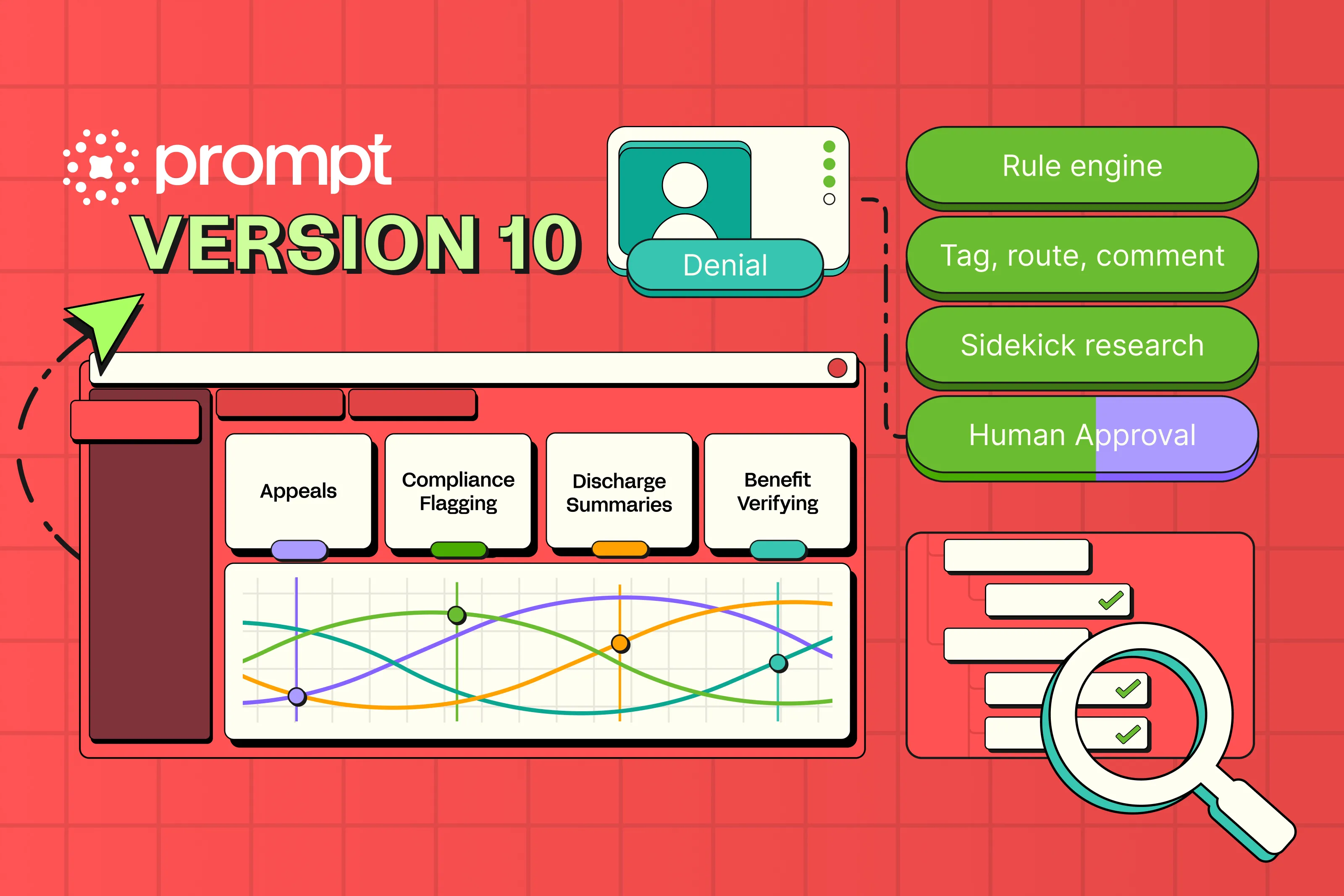
- AI-assisted coding validation reviews what was documented and flags underbilling in real time
- Payer-specific rules are applied automatically, so providers don't have to memorize every insurer's requirements
- Real-time alerts catch errors before submission, not after a denial arrives weeks later
According to AHIMA (American Health Information Management Association), reworking a single denied claim costs between $25 and $181. Which means catching just a few errors per week can save thousands in staff time and recovered revenue.
For multi-provider clinics, the impact is immediate. "Per visit, at the very least... it's 25% more just because nothing is being pushed out," Dr. Scott says.
The work was already done. Prompt makes sure clinics actually get paid for it.
5. Keep patients on track and schedules full
Gaps in schedules, missed visits, and manual calling don't just hurt the business; they interrupt patient progress. According to research published in BMJ Open Quality, outpatient cancellation rates range from 15% to 27% across healthcare settings. Per a systematic review published in the Journal of the American Medical Informatics Association (JAMIA), the global average outpatient no-show rate is 23%, with rates varying significantly by specialty and patient population. For chiropractic practices that depend on visit frequency to support care plans, every missed appointment can set a patient back.
How Prompt keeps schedules full
Prompt automates the work that used to require manual calling and guesswork:
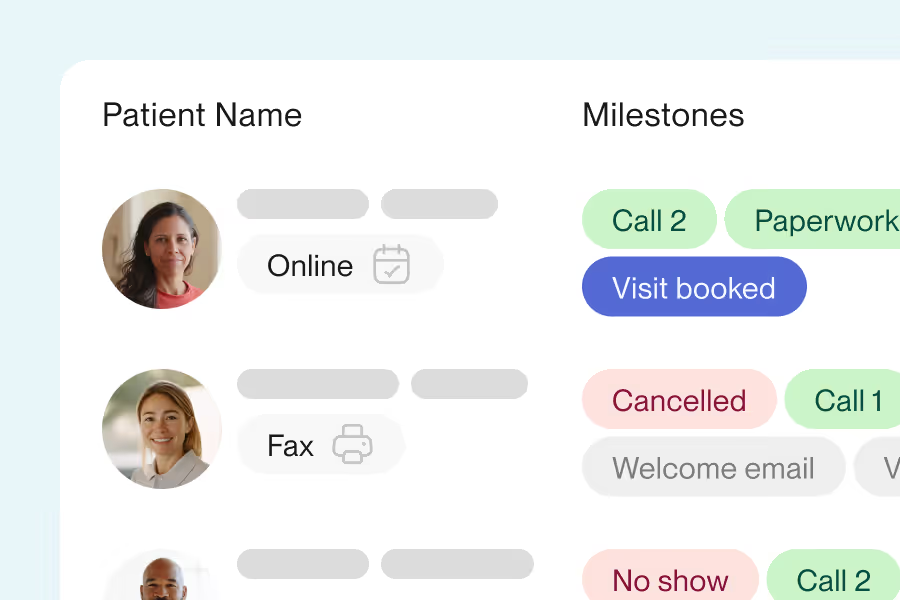
- Automated outreach reaches underbooked patients who can easily schedule their visits online
- Cancellation recovery proactively contacts the right patients to fill open spots
- AI scheduling optimization ensures the right patients fill the right slots, improving plan-of-care adherence
The volume impact is real. "I probably can see easily 10 extra visits a day," Dr. Scott says.
And the automation runs quietly in the background: "The software sending out unsolicited offers when there's an opening has made a big impact both on the number of patients we're seeing and the amount of money we're generating," Dr. Scott says.
Why chiropractors are choosing Prompt
Chiropractors haven't always been treated fairly by software vendors. Overpromises, slow innovation, and tools that break under real-world complexity are common experiences. According to the ACA, 77% of chiropractic patients describe their care as "very effective," which means the clinical side of chiropractic is delivering. The technology side needs to match that standard.
Prompt was built to change that. Our founders Mike Dwyer and Adam Baliatico set out in 2017 with a mission to drive extraordinary outcomes for healthcare providers and their patients. Chiropractic care is a critical part of that mission.
We believe in chiropractic care, and we're committed to being a long-term technology partner that removes burnout, reduces risk, protects revenue, and supports growth, quietly and reliably.
If you’re ready to eliminate these 5 pain points and build a stronger, more resilient practice, schedule time with one of our chiropractic experts today.
Frequently asked questions
What types of chiropractic practices does Prompt support?
Prompt supports solo practitioners, multi-provider clinics, and multi-location chiropractic groups. The platform is also used by multidisciplinary practices that combine chiropractic with physical therapy, occupational therapy, and other rehabilitation services.
How does Prompt help with chiropractic billing and coding?
Prompt includes AI-assisted coding validation that reviews documentation, flags potential underbilling, and applies payer-specific rules before claims are submitted. This helps chiropractic practices capture revenue for services already performed, rather than discovering errors after a denial.
Does Prompt replace my current EHR, or does it integrate with it?
Prompt is a fully unified platform that replaces fragmented systems. Instead of integrating separate tools for scheduling, documentation, billing, and reporting, everything lives in one system with a shared data model. This eliminates double entry and the integration failures that often come with multi-vendor setups.
How does AI scribing work for chiropractors?
Prompt's AI scribing tool, Sidekick, listens during patient encounters and generates visit-specific notes that reflect the actual conversation. It pulls forward relevant prior-visit context without copying language, which helps maintain compliance across re-exams and care plans.
Is Prompt HIPAA compliant?
Yes. Prompt is a fully HIPAA-compliant platform built with enterprise-grade security, role-based access controls, and audit logging designed for healthcare practices.
Can Prompt help reduce claim denials for chiropractic practices?
Yes. Prompt's AI-assisted coding validation checks documentation against payer-specific rules before claims are submitted. According to the AHA, denial rates across commercial payers have reached 13.9%, making pre-submission validation a proven framework for protecting revenue.
How does Prompt handle multi-location chiropractic practices?
Prompt's unified data model gives owners real-time visibility across all locations from a single platform. Scheduling, documentation, billing, and reporting all share the same data, which eliminates the double entry and integration failures that typically emerge as practices scale beyond one or two sites.




%20copy.png)
.png)