








Transcript
Marla: [00:00:00] Welcome to the Practice Growth podcast, where we're bringing together healthcare leaders and innovators to share their knowledge with clinicians, students, and clinic owners to help with practice growth and everything and beyond. So Mike, it is a pleasure to have you here today. Thank you so much for coming.
Mike: Thanks for having me. Looking forward to it.
Marla: You have helped with mergers and acquisitions for over 70 transactions and $150 million. You've really been an industry leader helping connect different practice owners for selling and also for practice owners for growth and being the acquiree.
Mike: Yes. Yes. Um, we've been around for four years now, over four years now, and, uh, it's been a, it's been a fun ride
Marla: It has, and it'd be really great to break that down into common sense about, all about what is happening now, the future of physical therapy, and the options that different clinic owners have, not only for sales and acquisitions, but also for growth and how they can become the next biggest and greatest.
Um, so would love to just start by hearing a little about yourself, how you got into this, and really what led you into the mergers and acquisition field.
Mike: Well, that is a long story, but, uh, probably worth the ride. Um, I am a physical therapist by trade. Um, I actually worked in a practice, uh, outpatient PT for about 10 years, um, staff PT, clinic director, all that kind of stuff.
Um, [00:01:30] got, uh, the opportunity to move into a management role, uh, where I oversaw about 20 locations in the Pittsburgh area, Pittsburgh, PA. Um, left the PT world for a while to do consulting work, where I was helping hospitals develop their musculoskeletal service lines. Um, but because my background in outpatient rehab, I got pulled into all of our partners that needed help with outpatient rehab, which ended up being virtually all of them.
So I ended up working with 45 different hospitals across the US, uh, developed a niche product with them that assessed outpatient rehab and consulted for outpatient rehab exclusively for roughly the last three to four years of my engagement with them. Um, but because I was working with a consulting company, I had access to a lot of training and experiences that you wouldn't get if I just stayed in the PT world.
Um, one of those things was how to appraise practices. Um, so that's when I started appraising practices back, way back then. Long story short, my old boss, who's now the chief operating officer at the company we grew up in, um, and he recruited me back as a vice president of operations overseeing 60 locations in Western PA and Eastern Ohio.
Um, and I was in that role for about two years when the CEO of the company wanted to start, uh, an M&A service line, a business development service line again within the company, and, and so I got the opportunity to move into a national role. That was [00:03:00] over seven years ago now. Um, and, um, was vice president of business development there.
Um, was in that role for just under two years when we sold that business to a much larger company. Um, was asked to stay on at that company as well, um, and stayed there. I was with them for four years, and then I got an opportunity to move to another company, a private equity-backed company, uh, that was conveniently located about 15 minutes from my house, or at least their headquarters was.
Um, so I was with them until COVID hit
Marla: Yeah
Mike: And then, uh, I was doing acquisitions the entire time, and when COVID hit, that changed everything in PT, right? Well, everything, period. Um, but in that space, since the acquisition train stopped there, I ended up leaving the company, and I started my own business a few weeks later, and I've been doing it now, um, what we say on the sell side, meaning helping people, business owners, um, sell their businesses, um, or help them acquire other businesses.
Um, so we've been at it for a little over four years now, so yeah.
Marla: Wow. That's a, that is a great story, and I love that you started out as a PT. You've seen all the different segments from a small clinic to managing multiple, all the way to the hospital system and the large enterprises.
Mike: Yeah.
Marla: And I know many people probably know you from online.
You really put out all the information about who's buying who, what a- [00:04:30] acquisitions have occurred in sales, um, and you've really been connecting different practice owners to their dreams or different owners becoming acquirees. So it's fantastic to see, and we really appreciate all that you do in the industry.
Mike: Oh, thank you. Appreciate that.
Marla: So now a lot of our listeners are... probably want to know very much what is merger and acquisition, what are the options? And I think in the past, it was sort of like you just sold 100%, that's it. You know, let's talk about 10 to 15 years ago. But now there's so many options available to practice owners to not only grow or to plan for an exit.
So would love to hear if you could break it down. Sure. What are those options?
Mike: So, uh, you're right. Um, years ago it was, you know, you pretty much just sell the practice and walk away kind of thing. Um, it just doesn't happen as much anymore. Um, it's more about partnerships now. At least most buyers, that's what they're looking for.
Um, so, you know, the options that you have as a, as a seller are you can sell to your, one of your employees, you can sell to a local competitor, you can sell to a strategic acquirer. Those are the name brand, uh, names that everyone knows across the country. And then... or you can bring on some kind of financial backer, whether that's private equity or venture capital or whatever.
Um, so those are the four main buckets that you have. Um- Again, most of the transactions nowadays are [00:06:00] in the strategic space. Not all, but most of them are in that strategic space. Um, and partnerships is more of the, you know, what most of these acquirers are interested in looking at. So, um, there are advantages and disadvantages to each.
Um, we'll just start with the selling to a local or, uh, an employee. You're dealing with folks that aren't very sophisticated in the process, so it generally, it takes, um, a long time and, and the success rate's not great on those. Um, people, you know, usually start by just negotiating a price when that's not always the best place to start.
Um, and then it goes downhill from there. Um, so, you know, um, that's option one, but don't see a ton of those. Um, we do see them occasionally, just... It's just not something you see a ton of. Local acquirers, s- slight step up in terms of sophistication level. Um, some of the folks have done acquisitions in the, in the past, and so they have a little bit of experience.
Um, but by and large, they're just not, you know, a strategic or a private equity group or one of those that does it all day long, um, every day. So again, a little bit more risk, uh, involved with those. I'd also lump in with the local buyers. Sometimes you can also hook up with a hospital. A lot of them, you know, that's, that's a, um, a, you know...
[00:07:30] Those can be national buyers too, yes, but for the most part, they're, they're local in nature Um, strategics, um, those are a-- I think the advantages with strategics or private equity is, A, you're dealing with sophisticated folks who know how to do transactions. B, they're very well-funded. They have a lot more money.
Um, so you know, you're probably gonna get a better deal and deal structure with, with the strategic or private equity than you are with a local or a employee. Um, and, um, again, it's gonna come down to trying to figure out what's right for you and your, your, your exit strategy. Because a strategic, you're looking at a partnership, so you're looking to sell, um, maybe roll over some equity, um, and, um, stay on for a period of time.
You know, whatever that period of time will, will be very dependent on, on the acquir- acquirer. But, um, with private equity, it's a, it's a different ballgame, or, or venture capital for that matter. You're looking to buy, and you're gonna be there for a while. And, um, the upside's much greater and, and the potential for growth is much greater with those, those types of op-opportunities.
So it's a risk-reward scale for you. Um, you definitely have the opportunity to do very, very well financially with those, but you're, you are-- usually, you are the person [00:09:00] they're building the platform around, so it's a lot more responsibility, a lot more, um, you know, a lot more, uh, work, so to speak. 'Cause if you partner with a strategic, a lot of those resources are already in place.
You have like an accounting and you have payroll and you have, um, um, payer relations, and you have all these pieces that are already integrated into the platform. They're already well-functioned. Um, and you know, you can utilize those to help you grow and scale your practice, whereas with the private equity, you're developing those in most cases.
Um, those don't just come along. They're, they're using what resources you've already developed and making them better. So it's a little bit more, um, you know, uh, uh, aggressive, a lot, a lot more dedication or, or, and timeframe, um, if you go with the private equity route or, or financial backer route
Marla: Thank you.
That, that's a great way of breaking it down and, and understanding that there are kind of the easier sales per se, but then if you wanna grow, there's a lot of options out there as well. Yeah. Um, and being able to put those processing procedures in place to be able to continue to be your own, your own boss, and eventually be the acquiree as well.
Mike: Yep.
Marla: So with that, tell me, what are three to five things that a owner can do to set themself up for a successful sale? What do you think really needs to be something they focus on?
Mike: Um, well, uh, first you [00:10:30] gotta have your house in order. Um, that means you're gonna have to have good data. You're gonna have to have good processes in place.
Um, you're gonna have to have a good plan. Um, so that is the bare minimum to be able to sell and, and, and do well. Secondly is to have realistic expectations. Um, you gotta understand what your options are from an exit strategy. Um, you're gonna have to understand what your goals are. And third is to find the right partner, and not always is the right partner going to be the one that just throws the most money at you.
Um, you can look at, uh, different deal structures and different ways that, uh, potential partners, uh, interact post-close that could be very, very influential in what's most important to you as a seller when y- wh- you know, uh, three to five years down the road, you wanna make sure you've chose that right partner so that you're not getting yourself into something that you're gonna be miserable with.
Um, so, you know, I think you have, A, get your house in order, B, have a good plan, and then C, when you go to execute the plan, make sure you choose the right partner. Those are the three things that I think are, uh, incredibly hel- helpful. Um, and for most folks, they don't even know where to start. So starting early is [00:12:00] critical.
Um, minimum, and my recommendation is two years out, um, a typical sales process will take ... If you're, if you're ready to sell today, it's probably six months until you can close. Um, so, you know, even if, you know, it's, it's, uh, September right now, you're talking into Q2, uh, next year already. Um, so, you know, that's, that's the first thing that people have to understand.
There's a s- there's a s- um, you know, it takes time. It's not like selling a house. Um, there- it's a lot more complex than that, and there's a lot of different bells and whistles and options that you need to understand. So, um, so just with that six-month timeframe, now take it a step further, is knowing what you want in, in a sales, in a sale of your business.
Um, a lot of folks just don't, you know, they, they think about the money part, but they don't think about Everything else. Um, deal structures or, um, what it's gonna look like post-close. Um, there's a lot of, lot of, uh, um, mis- misconceptions out there on what it looks like post-close. Um, so, you know, making sure you have your facts straight on, on, uh, what that's gonna look like, what you want it to look like, and how to find the right partner, um, to achieve those goals is gonna be critical, um, for someone to be successful on their exit.
So [00:13:30] what we do at, at my company is we work by starting with an exit strategy. Um, that exit strategy starts with evaluations. "Hey, you're- if you were to sell your practice today, here's what it's worth." Um, however, um, you know, I was a buyer in the industry for seven years, so, um, I know what people are looking for.
Um, I know, um, you know, what things are gonna resonate with, with buyers. And I look at your practice as if I were going to buy it, buy it. And if, um, there's something that is very appealing, we talk about that. But if there's something that's not so appealing, we, we spend some time on that as well and say, "Okay, if you were to fix this, you know, it could reduce risk for a buyer.
It could increase value, uh, purchase price or, um, whatever. It could change the deal terms, um, on o- the way the buyer looks at it." And, you know, we try and assign what we- what we'll call the, uh, time value of money to those things. "It's gonna take you six months to fix this, but it's worth X amount of dollars.
Is that worth it to you?" I don't ... I mean, it's everyone's got an individual approach there. Um, but we go through all those, the good and the bad, and we, we, uh, assign some, a risk value to it and say, "Okay, here's where you're at today. If you were to eliminate these risk factors or improve these risk [00:15:00] factors, here's what it could mean to you over time."
Um, in fact, we had some, uh, folks that approach us nowadays that, um, are, you know, very early on in their, in their, uh, process, and they have a goal in mind. "I wanna make X millions of dollars at, at close. Uh, I wanna do this. I wanna do that." And, you know, they're starting where they're at today, one, two locations, three locations, and they wanna know what do they need to do to achieve their goal.
And so it's the same thing. We, "Here's where your valuation is today, but to get to the target that you have, here's what, how you're gonna have to scale. Here's, again, how you're gonna have to grow. Here's the, the revenue and the EBITDA that you're gonna need to generate to get the, the return that you're looking for."
Um, you know, bringing all those factors in to that conversation allows them to develop a long-term strategic plan Um, and so you can attach time, time, uh, goals with that, milestones, and people will be able to, you know, set up a three, five, 10-year plan that will allow them to know if they're on track or not.
So that's why with us, it starts with an exit strategy, getting to understand our clients, getting to understand what they're trying to accomplish, helping them figure out what's the best, uh, strategy for them, helping them figure out what the best deal structure is for them, and then kinda reverse engineering th- everything back to [00:16:30] what they need to do to achieve those, those goals.
Marla: And that's where a lot of that consulting comes in, like you said. Correct. You know, you really are helping and looking at the whole practice and, and like you said, number one, which is getting your house in order, and you also mentioned data being extremely important.
Mike: Huge.
Marla: If you can dive into that a little bit more.
Tell us, when you say getting your house in order, like what are the metrics people are looking at? What's the data that needs to be shown and pulled, and how can technology make or break that with the systems that you're currently using?
Mike: Yeah. Um, today's day and age, you know, everyone should be able to produce your basic metrics, your visits, your new patients, your units, all that kinda stuff.
Um, believe it or not, we still work with some clients that just don't ha- their, their systems are old. They don't have the ability to generate very simple reports. Um, so that is a challenge right off the get-go. If you're, if you're not working with an, uh, you know, EMR platform or something that can produce just basic reports, then you're, you're behind the curveball or, or you know, behind the eight ball already.
Um, financial reports, extremely important. Um, making sure that they're set up correctly. Um, if you have multiple locations, being able to produce a P&L by location is als- also, uh, some folks are able to do it, some folks aren't. Now, that's not gonna crush a deal, but it's, it's definitely helpful when you're able to.
The more of these things that you can check a box with, the more comfortable the buyer's gonna be, um, you know, with your [00:18:00] practice. Um, today's day and age, we have a lot of challenges just with documentation, coding, and compliance. Um, so tools that allow folks to document well and to schedule compliantly and, and, and those kinds of things become very, very important.
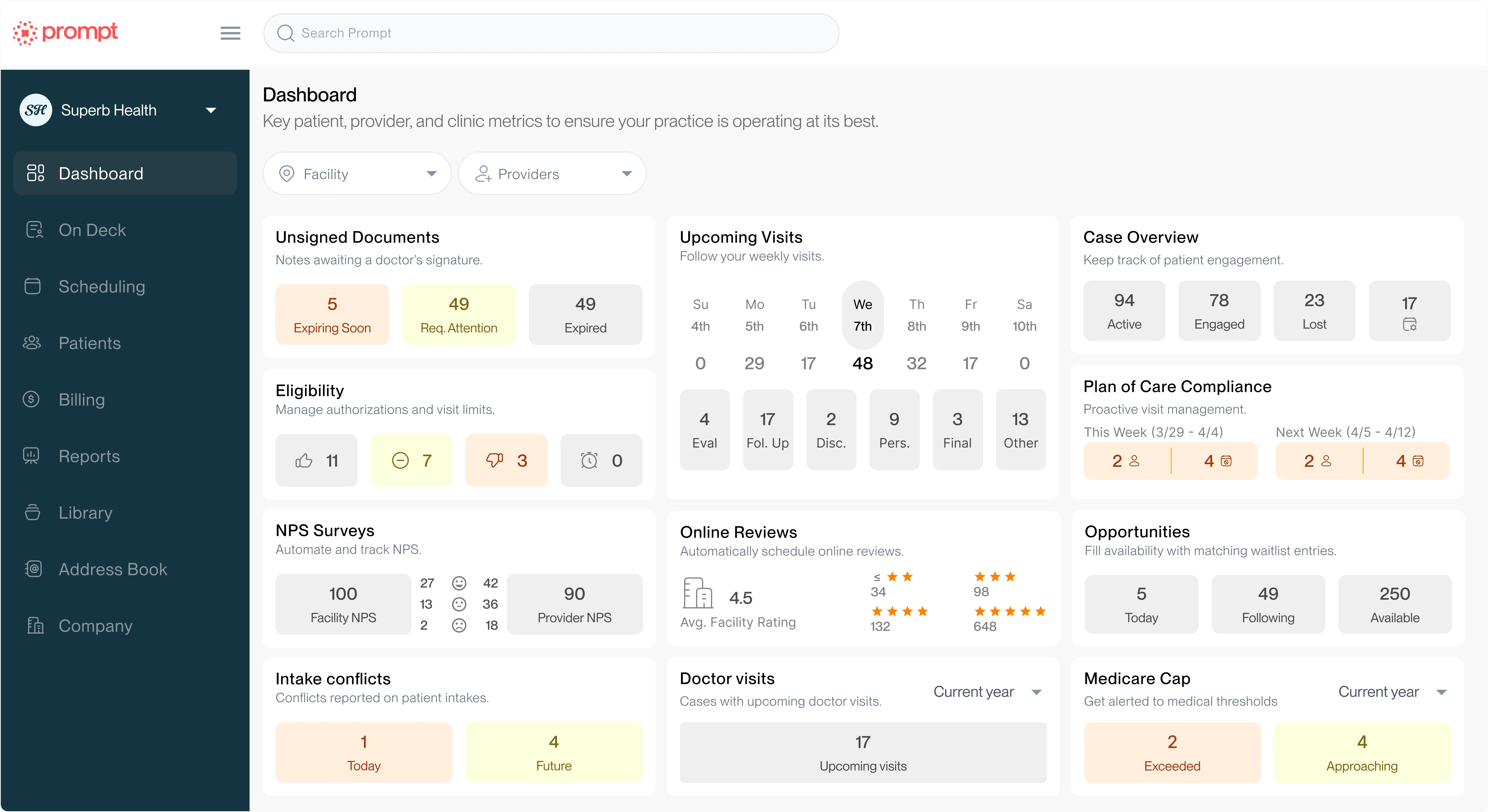
Um, so things like, um, since we're working with Prompt today, um, the PredictionHealth, uh, tools and AI, um, tools that, that they have with the, with the dictation abilities, um, tend to make the, um, scheduling, documentation, all those things a little bit more compliant, a little bit better. And again, it reduces risk from a buyer's perspective and makes it more attractive
Marla: I love that.
Thank you for mentioning the, the different pieces and really taking on that getting that house in order and being able to see the, the forest and the trees is if you, you do this and make these changes, you actually can have a higher valuation. Right. Or you can be a more attractive to a seller because of what you put some effort- Yeah
and put into place.
Mike: Think of it this way, it's risk. So, uh, uh, what a buyer's looking at is how risky you are. The l- the least, uh, the, the less amount of risk that they perceive, the more aggressive they can be in either their, their valuation or their deal structures or those kinds of things. So the better deal you're gonna get with a, [00:19:30] uh, the, the lower the risk your, your list threshold.
So those are the t- those tools help you lower your risk threshold.
Marla: Great. Great. And you also said be very proactive two years in advance, be thinking about this. Do you ever recommend brand new clinics, even just starting up, to bring in someone to help them consult for their goals in five, 10, 15 years?
Mike: Oh, yeah.
We've, we've done that with several clients, uh, who are very, very early on in their journey. Um, and again, it sets up that long-term goals, those long-term goals for them, depending on what those goals are. Um, then a periodic reassessment. Um, again, a lot of the things when we go through that, even initially, uh, I'll just bring an example of a client I did, I don't know, three years ago, um, that, uh, three locations and, um, you know, were doing great financially, but then when we started looking and peeling things back- They might, you know, they had some things that I wanted them to look at compliance-wise.
So we, you know, get them set up with a compliance consultant to, to look at their, their stuff and help them make sure that they're, um, you know, scheduling, coding, documenting everything more compliantly. Um, and so that it, that, uh, they're not putting themselves at risk, number one. Um, but number two, when they are ready to sell, they're not gonna have a compliance issue, um, which can be, uh, very problematic for, for deals, so.
Marla: [00:21:00] And I'm sure you've had some groups that potentially were looking to sell and you came in and did some consulting, but then actually showed them that if they changed some pieces, they were able to grow and continue to grow. So that's where I'd love to also just turn the tables a little bit as I know a lot of prompt clinics no longer are per se selling right off the bat.
They're actually just growing quickly. Mm-hmm. And would love to hear a little more about how they can become the acquirees, say a brand new startup that's continuing to have the right resources and process in place and now is growing organically. Um, what tools and consulting and resources can you bring to them to help them get to that phase where they can be the acquiree?
Mike: Yeah, sure. So, um, these are folks... Again, you start with that exit strategy. Um, these are folks that are just starting out. So here's what... Here's how the process works when somebody goes to buy you. Here's what, you know, here's how a buyer looks at you. It... That is a, in and of itself is a skill that a lot of people just don't know much about, um, because they're clinicians, they're businesspeople.
They're, th- they're not appraisers of, of, of practices. So starting there, here's what your practice is worth today. Okay. Working with these businesses and, and saying, "Okay, well, I want it to be here. I want it to be worth X amount of dollars. Well, how do we get there? What are the things, what are the steps that we're gonna be a- we're, [00:22:30] we're gonna need to do in order to get from where you're at today to where you need to be?"
Um, so just laying out that roadmap. That roadmap could be that you need to add more locations or you need to, um, fix certain things. But if it's adding locations, you're gonna basically have two options. You can do a de novo and, and startups and, and continue to grow probably the way that you started, or you can start to do acquisitions yourself.
Um- So, you know, again, I kind of mentioned early on that some of these large strategics, these are a lot of them are very well-oiled machines that do acquisitions all the time. So they're very comfortable doing them and they know what they're doing. They know how to do them and they can do these deals very, very well and very quickly.
I mentioned as a local acquirer, which if we're talking about these size clinics that are maybe three, four or five locations, whatever, you know, they might not have the sophistication to acquire. So you're going to have to do something to help get you educated to get from where you're at today to do an acquisition.
You're going to need some help, I think, in most cases. You know, whether that's through consultants such as ourselves or, you know, working with very experienced lawyers, having a good compliance team around you that can assess a practice, having [00:24:00] other Billing, coding, documenta- like all these different folks that can help you, uh, kick tires on a practice if you're interested in buying it.
Um, you know, all these different resources and all these different things that are gonna be important just to understand if this is a good acquisition for you or not. You just gotta make sure you're checking all the right boxes. And if you don't know which boxes to check or you're, you're unfamiliar with the steps to go in, you could set yourself up for, you know, doing an acquisition that wasn't a great fit or wasn't, um, you know, isn't going to produce the way that you thought it was going to produce.
So, you know, getting somebody that has some experience in that and helping you make some decisions along the way is gonna be critical. Um, the, the main thing I would say is get help. Just get help because you're gonna need somebody as a second set of eyes, usually outside the organization, um, just to make sure you're not missing anything.
Um, 'cause, you know, there's so many moving parts in an acquisition, and there's so many different ways to solve for problems that you just have to have someone with a little bit of experience to help, um, figure out the- navigate the path through.
Marla: And how big do you recommend a clinic to be before they start acquiring new practices?
Mike: I mean, you can make it your first ac- um, practice if you, if you have sufficient funds and, and the ability to, um, to do a deal. Um, it's gonna come down to your, [00:25:30] you as a individual, your risk tolerance because if you're borrowing money to do that, you're gonna have to borrow a lot of money to, to buy a, a nice practice.
If you're, um, scaled enough where the company's generating cash and has a lot of cash on hand, it's a different story. Um, you have, you have the ability to self-finance or, or, you know, um, be able to acquire that way. So it's really more a question of finance and risk tolerance than it is, um, size, I would say.
Um, because I've seen people go fr- you know, for their first clinic is an acquisition. So it, it happens. It happens more than you think.
Marla: So no size is too small or too big.
Mike: Right. Right.
Marla: Um, and what are... what should they be looking at? What... Give me three things off the bat that they should absolutely look at before acquiring that company.
Mike: Um, so, you know, when you're going to buy a company, again, we mentioned a little bit about risk. You're gonna have to be able to assess the risk of buying that com- that company, that, that, that practice. So, you know, A, is it a good fit for you? I mean, I would just start with- The way that they operate, is it very similar to the way that you operate?
Is it, um, in a geography that is right for you and whatever you're trying to achieve? So very simple high level things. Um, secondly, if you are, you know, interested in acquiring a practice, don't start off with just establishing a purchase price. [00:27:00] Get, get to understand the practice, get some information about the practice.
Um, unders- you know, make sure that you at least have a high level knowledge of the, of the business to ... and screen for very simple things that could be problematic. Compliance issues, coding issues, um, um, financial issues, if they have a lot of debt or, or those kinds of things. Um, 'cause that's gonna influence either how you approach a, a, a purchase price, how you approach a deal structure, all those kinds of things.
And then once you are ... you find you've done enough diligence that you feel comfortable with that business, um, now you're gonna have to come up with a g- good offer. Um, and you're gonna have to ... it's gonna have to be thoughtful. Um, you know, and you're gonna have to, um, also have the resources and the knowledge behind you to help you get through a diligence process and a legal process and, you know, the
and h- finally the financing process. So all that kind of stuff. So lots of things to think about. Um, um, so again, just get somebody that, that knows what they're doing to help you make sure you're checking the boxes and you're not, you're not missing anything. 'Cause if you screw up one of those things and you do an acquisition, it could be, it could be a blessing or it could be a burden
Marla: Yes, definitely want to make sure it's a blessing.
Right. All of our hard-earned work as clinicians, we want to make sure that we continue to grow and, and excel to the [00:28:30] next level, um, and get rewarded for what we've put our
Mike: efforts in. 100%, yep.
Marla: So now I also know there's some MSOs popping up, um, managed service organizations where clinicians and practice owners are starting to kind of formulate together and offer different structures where, um, n- they don't necessarily have to have practices sell anymore, but again, that partnership model.
Can you explain a little bit more about MSOs and how those fit into the landscape right now into this industry?
Mike: Yeah. Well, the MSOs, um, they're, they, they come in a lot of different shapes and sizes. Um, what you're referring to is, is really these are parent-level organizations that have, um, centralized functions, um, within their MSO.
It's usually, you know, accounting, billing, compliance, those kinds of things. The things that all the pr- all the locations are gonna need. So those would be centralized within the MSO, and the MSO would provide those services to those locations. Um, and sometimes there's a fee attached to it, sometimes there's not.
There's ... It again, depends on what the accompl- or what they're trying to accomplish. Um, so the MSOs, um, are really are no different than Anyone else, they might say that they're, you know, one, one organization might call the- themselves MSO, another one, um, does partnerships, and they're almost the same thing.
They almost function the same way, right? Maybe legally they're a little bit [00:30:00] differently, different and all that kind of stuff, but, but they function very much the same way, where the- you're gonna have the ability to provide centralized services through, through this MSO. Um, and you're, you're still gonna be able to maintain, in most cases, uh, uh, some equity, uh, some, some equity, sometimes local equity, sometimes parental equity.
It, it's a whole different s- topic altogether. But, um, you'll be able to maintain some level of equity, um, lo- um, at that, at your practice. And, um, then I think that the benefit to all those, those partnerships really comes down to when you go to sell your minority equity. And again, that's gonna happen a lot of different ways with, with different buyers, but, um, the, the, the main opportunity there is an arbitrage opportunity.
So, you know, as a single location practice, you might sell your practice, you know, at, uh, three or four multiple, maybe a five multiple if it's a really, really great practice. Um, and, um, but when a larger company goes to sell, I mean, generally that number is gonna start at a 10. Um, you know, uh, maybe even more than that.
I mean, large- the largest companies might be 14 or even a 15 or something like that. So, um, there are things, uh, that you can build into deal structures that allow you some, uh, drag along and tag along rights that allow you to participate [00:31:30] at a much higher multiple than you would, um, you know, if you were selling your practice on, by yourself.
And so, you know, you just, you have a, a million-dollar practice. You roll over some equity, um, let's say 20%, that's $200,000 worth of EBITDA that you're rolling over or, or valuation value that you're rolling over. And then that, that portion, that 20%, you scale your EBITDA again with, with the new company, and then you go to sell that, that 20%, even though it's only 20%, but it, it's, it's now you get, uh, an eight or a 10 or a 12 multiple on it Uh, that's a heck of a lot more money than what you started with.
Usually it's, you know, it could be as much as what you sold the practice for in the, in the first place or a lot more if you, if you're, uh, hel- uh, did a great job in scaling it over that time.
Marla: So it's just another way of outsourcing a lot of resources while keeping some of your stakeholder or equity, um, to be able to grow your own practice but have access to potentially, uh, insurance rates and, and compliance and HR.
Mike: All those things. All those things. Yeah. Um, one thing we should probably mention there is just the, um, you know- That partnership model is not something that you can sell and walk away. Um, so, you know, most people need to be thinking two, three, four, [00:33:00] five years in advance of when they want to retire or when they're ready to walk away because if you sell to, uh, in a partnership model, you're gonna have to be there for a while.
And, you know, so now it takes you six months just to sell it. Maybe you had to prep it beforehand, so now you're two years before you sell it, and then you gotta be with them for another three to five years, um, before you can, um, participate in that arbitrage opportunity with the- with your rollover equity.
Um, so, you know, um, it's a- it's a long-term plan. That's why we, we, you know, again, we- we push a lot the exit strategy, make sure you understand all these concepts and making the right decision for you and your family. So, but the- the time to sell and take advantage of that rollover equity, it's not right away.
That's- that's the main thing that people need to understand. It's gonna take some time.
Marla: Yeah. And- and like you said, it's- that's really good for the clinicians who are ear- early out and they still wanna be part and they still wanna grow, but maybe are a little burnt out. Um, and I think that all the resources, like you said, being able to access the greatest and best technology, the, um, teammates that are gonna be doing billing or that are gonna be doing all those parts that maybe you don't wanna do as an owner is really engaging.
Um, I do see a lot of burnout happening, and hopefully we're seeing a lot less of it with clinicians using great technology. Um, but we wanna make sure they have a good [00:34:30] strategy and structure to go to.
Mike: One of the things that I would mention, though, that, um, a lot of these folks are getting burned out, um, I mean, there are a lot of different reasons for that,
Marla: you
Mike: know.
But if you can eliminate the stuff that annoys you, that- that makes it hard for you to go to work every day, like most clinicians that I talk to love to treat. They- they wanna be able to do that, or- or they like love ... Maybe they love to grow the business. They wanna focus on that. They don't wanna focus on payroll and payer relations and compliance.
That stuff drains them of energy. So if you can find a partner, if that's- if that sounds like you You know, y- if you can find the right partner to take that stuff out of your, you know, your day-to-day activity and you can focus on what in- what inspires you, you're not gonna be burned out anymore. You're gonna be inspired and kind of, you know, enjoy going back to w- to work every day because you're focused on what, what excites you.
So I think that's where, you know, these partnerships, the MSO models, it's thinking two or three steps ahead as to when you wanna exit, and then finding the right partner that will allow you to exit on your terms.
Marla: Yeah. And I think it's so important you mentioned earlier about that cultural fit. Um, it, it really is.
There are so many out there. It's important to find what is the best fit for you, your culture, both ways, whether you are be- being the acquiree or being acquired or selling [00:36:00] because, um, going to work every day and loving what you do, you want that culture surrounding it as well.
Mike: 100%. I think, um, when you're looking...
Well, I, I work with the acquirers every day, and the number one thing that they're looking for before they even entertain, if they're gonna look at their KPIs and all that other stuff is, is this gonna fit? You know, is, is there good... Is there potential for good cultural fit? Because the last thing that they want to do anymore, you know, back in the day, they used to just close deals, right?
Now, if it's not a good fit, they're, it's, it's... They know that it's not gonna work, and it's not gonna work for my client as a seller, and it's not gonna work for the acquirer either. So, you know, finding that right fit, when you do find it, it feels right. You'll, you, you... It's kind of like, uh, the Goldilocks prin- principle.
But, um, but it takes... It, it's not one size fits all. Everyone's, uh, all the acquirers are a little bit different. Every seller is a little bit different. So you gotta find the right mix, um, that, uh, has a good, uh, philosophical, cultural fit, and then the right deal structures that, that work for both sides as well.
Marla: And can you give me an example of something that you may have had a clinic change, some red flags or something that you saw that made a significant difference in the end?
Mike: Yeah. So, um, probably the most significant thing that we'll, we'll come across from time to time is, [00:37:30] um, compliance related. Um, so, um- You know, m-m-most of the acquirers out, not most of them, all of them out there are very highly scrutinized by CMS and everyone.
They have to run a squeaky, squeaky clean business. Um, so, um, you know, when we do see compliance challenges, typically that's on the smaller practices. They just didn't know something or just aren't set up the way that a, a, a large buyer has to, uh, uh, work or ha-has, has to adhere to this, that, or the other thing in order to make it work.
So that's a, that's a, that's probably the, the area where we see real, real challenges. There's something with the compliance. It's scheduling, coding, documentation, whatever that just doesn't fit, and, um, so that's not always an easy fix. Um, so if you do have a challenge on those, going back and, um, fixing those, um, before you go to market is critical because, um, if you were to go to market before that were to happen, most buyers during the diligence process would identify that, that as a red flag and get kicked out, and you probably won't, aren't gonna be able to close the deal.
Or if they do, they're gonna change the deal so much that it's not gonna be real attractive to you as a seller anymore. So, um, [00:39:00] so, you know, fixing that and then going to market, um, with a, with a clean, you know, uh, record, clean compliance program in place that's, uh, still producing good results, then now, now you have something to sell, and now you have something that, uh, that the buyer's, um, happy with that, that they...
It's gonna be running very similar, uh, if not exactly the way it was, um, uh, prior to close because you're already, you're already, uh, doing all the things that they need to be done from a compliance perspective. Um, we've d- we've gone through several, uh, clients in the past who've had some challenges, some red flags pop up during, you know, during our exit, um, planning strategies and, um, they went back and fixed them, and then over time, you know, were able to pull off successful sales.
So, um, you know, at, at the end of the day, that's probably the one that, that is the most dramatic and the hardest to, to, um, swallow as a, as a seller. Um, um, but it's probably also the most m- most, uh, fun one, you know, when we go to sell and you get it done Yeah, everyone's kind of happy.
Marla: And percent EBITDA, what should people be striving for as a really good percent EBITDA that they're making in their clinic?
Mike: Um, if you're not doing a, a 10% now, you're going to ... It's going to be, you know, risky from a buyer's perspective. So, you know, 10% is probably the start. Um, if you can get that, [00:40:30] um, in the 15% range is pretty solid. 20% or, or higher, you- you're doing really well. So, um, you know, again, it's gonna depend a lot on markets.
So, um, for instance, if you're in a low reimbursement market where the margins for that particular market, y- you know, at 10% might be great. Um, but then you go into another market where the reimbursement's much more favorable and 10%'s low. So it's hard to say exactly unless you know geography and, and, and those kinds of things.
But, um, you know, I'd say start at 10% on, on average if we're just kind of spreading it across the country and, and go from there.
Marla: Great. And how much do you feel technology and your EMR plays into just like you said, the clean house, the base?
Mike: You gotta have your house in order. A- and quite honestly, what I don't understand is how people manage their business without good tools.
So, you know, having the ability to understand, you know, operationally where they, where your metrics are, your KPIs are relative to national standards. I mean, when I was an operator, we looked at that stuff every day. Um, so, you know, um, I ... As business owners, I would think that you want to at least have a plan about how to manage those things.
Um, know-- make sure you know what good numbers look like, and then, you know, how, how you work with your staff to make sure that you're [00:42:00] getting realistic, good, solid KPI numbers, uh, from a, from an operations perspective. The same thing with financial though. Um, having the right tools, uh, account, uh, i- whether accountants or bookkeeping or whatever that allow you to be able to, um, manage your business financially.
You know, what is a good number for your, your EBITDA percentage for, for your market? What is a good number for percentage of labor relative to, uh, to your revenue? Um, um, facilities expense, um, all those kinds of things are do- You know, you ... We can line all these up. We see very commonly, you know, in, in from looking at financials- That most, um, high-level buckets of expenses fall within a pretty tight range of, of the, uh, percent of revenue.
So you can kind of look and see is there any of these, any of these expense buckets out of whack.
Marla: Yeah.
Mike: Um, so you should know that. You, you should have an idea of what those expenses look like and, uh, are your, are... is your spend good for, for a practice like yours? Um, so, um, uh, being able to, if you have multiple locations, being able to look at each practice individually from a financial perspective is important, you know?
You could have one practice that's producing all of your EBITDA and another practice that's an anchor. Um, and so you c- helps you make financial [00:43:30] decisions or make operational decisions, strategic decisions knowing that level of information. If you don't have that information, you're, you're driving the bus blind, and that's, that's a little scary sometimes.
Marla: Yeah. And I, and I know right now, I mean, there's all these other pressures going on with reimbursement rates decreasing and, and so forth. But earlier when we were chatting outside of here, you had mentioned that good clinics that are actually running their business well, um, they're in such high demand right now.
Mm-hmm. And that there is a huge market to be able to keep growing and be the acquiree or to have a sale and, and exit out. I mean, it... Love to just hear some of your thoughts and takes on that because I do think that it's actually a really positive outlook happening right now.
Mike: Well, yeah. So, um, you know, I think what we're seeing right now is a lot of the practices that come either, uh, are looking to be sold, either they're coming through us or going directly to an acquirer, whatever.
When we look at them, um, start to peel back the layers of the onion, there's some real challenges in those practices. And so, um, it's hard today because of all the challenges. You got, you got reimbursement has always been a challenge. Payer relations has always been a challenge. Staffing is the number one challenge that we're seeing in the industry, period, bar none.
Um, I- all the clients on my roster right now, I think it li- I think all but maybe one i- is looking for PTs right now. Um- Yeah ... so that's, you know, from a business [00:45:00] perspective and from a meeting the need in that community perspective- We're lea- We, we, we don't... We're not op- optimized in the performance of that practice.
Um, you're not generating the financial results if you're, if you don't have all the staff, so things like that. Um, so you're... I think what we're seeing in the market right now is there's a lot of businesses that aren't optimized and, um, you know, that's not the best time to sell. Um, but, um, when you do have a practice that is in, in good position, I'm not saying they can't sell without, uh, having all their PTs in place, but if they're really strong in all, all the other, uh, facets of their business and they're just missing one PT, we can sell that business.
Um, but if they're, um, you know, um, not functioning well, um, in other areas, you're just, you're just leaving a lot of, um, money on the table, and that's where an exit strategy might, might, might look, um, good to you Um, however, those practices that go to market right now that, um, are in good position, they're doing very well because there's just not a ton of them out there.
Um, so when you get a good practice, you, and it goes to market right now, you're seeing a lot of buyers very interested in those practices just because there's not a ton of well-run businesses out on the market today. Um, I'm sure that will continue to evolve and change over time, but, um, that's ... It is a very good time to sell [00:46:30] in, in my opinion, um, if your, if your house is in order.
If you, if you have all the, all the pieces in place, it's a good time to go.
Marla: So investing in the resources early and investing in the tools, process and procedures is really gonna set you up for either pathway, growth, sale. That's really, um, what I, what I hear you saying- Yeah ... over and over today. Yep. That those kind of pieces, a lot of people say, "It's a cost.
I can't add this on. I can't add that on." You're saying it's really an investment. Yes. All of those different tools is gonna help your practice be cleaner and be better for the next step.
Mike: Well, in, in a lot of cases when you do it right, it's also a financial, um, financially positive for the practice too.
Marla: Yeah.
Mike: Um, so in the long run, you know, um, you're reducing risk. Um, you're, you're probably making your practice more valuable, but you're, you ... If you do it well and you do it, um, a- and, and you do it the right way, it ends up being you, you end up getting rewarded because the, the, uh, financial results start to, start to follow.
Marla: Yeah. And you attract talent. Yeah.
Mike: And you attract more talent and yeah.
Marla: Yeah. Well, this has been great. I really appreciate it. I love hearing all about M&As, the industry growth, and, and the positive parts out there where it really is wide open. Um, there's a, a lot of interest in this industry, and you see that by the VCs and the, and the private equities wanting to invest in companies.
So putting all of your [00:48:00] house in order and, and thinking about it early on, maybe bringing consultants in, um, even when you start, is gonna really lead to a much better outcome, whatever it is that your strategy is. Um, I think that's a, a great point. It's never too early to start, and it's, um, never enough to think about investing in your practice versus just putting down the easy resources.
Agreed. Agreed. All right. Well, Mike, I really appreciate it. Thank you for coming in today. Thanks for having me. It was great.