





.png)
Transcript
Marla: Welcome, everyone, and thank you so much for joining today's webinar, The Connected Future of Rehab is Here: From Referrals and Records to Outcomes. And I'm Marla Ranieri. I'm the head of clinical innovation and clinical strategy at Prompt Health, and I'll be moderating today's session with a fantastic group of panelists.
We're so excited to have all of them, and we will introduce them shortly. But really the whole point of this webinar today is that for too many years, rehab has lived on the outside of the healthcare system, almost on our own little island, and if you think about the way the patient moves through healthcare today, their information may live with the primary care provider, orthopedic specialist, hospital system, and payer, but by the time they come to rehab, suddenly we're asking the patient to help connect the dots.
We're asking them to bring their referral, to bring their medical history again, to fill out another form. I mean, all of you guys have experienced this as patients and as providers, and it's just we're trying to figure out what happened before they got here. But on the other side, the providers who sent the patients, they also have little visibility into what happened once they got to rehab as well.
They wanna know, did they schedule, did they show up, what are their outcomes? It's 2026. It should be better. We should be able to hand those patients in pieces of paper and asking them not to carry them from healthcare to healthcare, but really to be able to have an interoperable, [00:01:30] interconnected system where everybody can share communication, can go back and forth, and where you feel like you're truly being taken care of.
So that's all about what we're gonna be talking about today. How do we eliminate the facts? And that's the smallest part of the conversation. The bigger opportunity is what happens when information can truly move with the patient, when rehab can receive information from the rest of the system, send meaningful information back, and when we're able to do that, that's how we're gonna move in past this little silo and island, and start to become able to show the value that we drive within rehab to physicians, ACOs, payers, health systems, and the rest of the care team.
And hopefully, that's gonna give rehab a much bigger seat at the table, and we can continue to operate as a care team together So overall, really excited to talk about this, talk about what's possible today, what's currently happening, and what it can look like in the future. So before we get started, I'm gonna do a little housekeeping.
Um, we want this to be as interactive as possible, so you'll see there is a chat on your right. Please feel free, go ahead and write as much as you want in that chat. You can go ahead and introduce yourselves, say hi to everybody. Um, we do wanna make sure that you guys are connecting with each other. But if you have a question, there is a Q&A button at the [00:03:00] bottom of the screen, and that's really where we want you to ask your questions.
This is so that we can answer it later in the Q&A session. Um, also so that if we don't get to it today, we can always email you later and answer all of those after the fact. And as I said, we wanna hear from you, so we're gonna start with a little poll. You'll see it pop up on your screen right now. And basically we wanna know from you, if your organization could solve one connectivity challenge tomorrow, what would create the most value?
So please go ahead and add that into the poll. As I said, you'll see it pop up on your screen. Um, and that's any of these: eliminating manual referrals, automating and receiving patient information, um, exchanging signed plan of cares, all of the above. So please feel free to go ahead and fill that out right now.
And I see a couple messages coming in the chat, just introducing yourself. Again, please feel free to do that as well.
All right. Great So looking through all of these answers, uh, it looks like we've got a lot of different reasons. Some all of the above, some different pieces, and that's really interesting while we look at this, is that information isn't moving easily enough between organizations. Um, so this is really where we [00:04:30] can use technology to bridge this gap and help eliminate some of those time-consuming manual workarounds, and that's what we're gonna unpack today.
So let's introduce our panelists. Um, first and foremost, we have Therasa Bell. Therasa, so good to have you here.
Therasa: Thank you, Marla. Super excited.
Marla: And Therasa is the president and co-founder of NoTo. She combines deep clinical insight with technology leadership and has spent years solving some of healthcare's most persistent interoperability challenges, and she's gonna help us understand the big picture, how we got here, and the vision for connected care.
We are also joined by Matt Becker. Matt, it's a pleasure to have you as well.
Matt: Thank you, Marla. It's great to be here.
Marla: And Matt is the senior vice president of interoperability and policy at No2. He oversees projects aimed at extending interoperability into hard-to-reach markets and groups that historically weren't part of the government incentive programs, and helping to drive interoperability to include therapy.
Thank you so much, Matt. And finally, we have Jack Usie. Jack, such a pleasure to have you as well.
Jack: Hi, everyone. It's great to be here.
Marla: And Jack is the senior product manager at Prompt, and he is overseeing Prompt's hospital interoperability product and strategy, and he's gonna help us connect all of the dots back and forth into how the rehab workflow works, what interoperability looks like inside the EMR today, and where Prompt and No2 are [00:06:00] going together as a partnership, and how it connects to the broader picture of the future of rehab.
So let's dive right in, and Teresa, we're gonna start with you. Um, we, like we said, we want to understand the big picture. So what problem did you see in healthcare that made you passionate about solving interoperability?
Therasa: You know, I thought a lot about this question, Marla, um, 'cause I get asked it a lot, but I thought it would be appropriate to take a little trip down memory lane.
For those that don't, that don't know me, um, it's important to understand some background. So I grew up in a family, uh, that was very nerdy, and so I grew up with engineers. My dad was an engineer. I was surrounded by engineers and software. Actually, we had the first, one of the first models of the compact PC came to my house, and yes, that's real.
That's how old I am, and that's what I ended up knowing. So I was always very much, uh, driven by the software world, by engineering, by hardware, all of it, 'cause that's what we did every day. But when, you know, I was mid, you know, mid-teens, I wanted to be kind of a rebel without a cause and I was gonna go the opposite direction.
So while everybody assumed I was gonna go the same path, I was gonna go into healthcare, and I always had a passion for healthcare providers. The problem was is I didn't like blood, so I couldn't see. I would faint at the sight of blood. I couldn't do anything, so I knew it wasn't actually gonna be, like a physician or somebody that's working with a lot of bodily fluids.
And so I went the [00:07:30] other direction and I said, "You know what? Therapy." I actually was gonna go into physical therapy, and I had a lot of passion for it. But my dad was a very smart man, uh, so he had me, uh, actually go visit. We had a- neighbor that was a physical therapist. She had her own clinic, and he had me go visit.
And good thing he did 'cause what I found out quickly is was I was not designed for all of the hard work and the compassion and the pain that I saw patients going through, but I knew I wanted to service healthcare. Um, so I couldn't defy my genetics anymore, and I had to go into engineering, so that's what I went to school for.
Um, very much surrounded, surrounded by healthcare, so I've had a passion for it from the beginning. Uh, I completed my schooling, and I've had the privilege of sitting and had the privilege of sitting in all, basically all care settings and all healthcare settings. So I've sat at the health system. I've sat in a provider's office.
I've sat at the payer's office. I actually worked for a vendor, uh, that very specifically serviced healthcare audiences, and it became very clear, um, now we're talking decades, it became very clear how broken healthcare is, uh, meaning from a communication standpoint and how challenging that was going to be to solve.
So as I sat in these care settings, it also became very clear to me that the word healthcare was a very big word. So as you looked at the different healthcare settings, and especially in the provider space, you know, how... what a, what a physician cares about to a behavioral health provider to a dentist to a physical therapist.
Although they have [00:09:00] commonalities and obviously the patient being at the center, they're all very, very unique forms of business. They're all very distinct in terms of the data they collect, in terms of the workflows, and that made the interoperability challenge even harder, so the ability to communicate.
And it, it became obvious that this was the reason that fax was and is still so persistent. Because it was a common way to share information, and everybody could do it. Everybody had a fax number. Everybody understood it. And I knew that was kind of my starting point for what problem we needed to solve, and it was the communication problem in very disparate industries at scale.
So we had to solve this problem and do it at scale. So the question I'd always ask myself is, a- and the thing that, you know, p- people always say is, "How do you eat a whale? You eat it one bite at a time." And so the first problem to solve was to connect these disparate Parts of healthcare, I always say connect all four, four corners of healthcare and do that through a single network.
So we have spent the last, uh, when I started the company now fourteen years ago, we've spent the last fourteen years literally laying the pipes across healthcare to connect all of these different places. So we've plugged in everywhere all of these different forms of communication. So whether it's a fax machine, somebody's using a portal, somebody's using an electronic HL7, you know, now FHIR being all the rage.
All of these were different ways that communication was occurring, and they needed to be brought into a centralized network, one way to do that [00:10:30] across the United States. So I proudly say we do that today, um, and that has been a lot of work, a lot of wrench turning, so back to my genetics here. Uh, a lot of engineering and time spent laying the foundation for the network in healthcare.
Now, today, what, what drives my passion today, um, is the real healthcare challenge that the United States is in. Specifically, you know, we, we have about, about a little over five trillion dollars of the US GDP is spent on healthcare, and that's the most amount of money spent in any developed country worldwide.
But yet we have the worst outcomes. And twenty percent, almost twenty-five percent now of that five point three trillion dollars is waste. And they identify that waste according to administrative complexity and failures in care coordination. So the reason we're all sitting on this call today are those fundamental reasons.
So looking at that, saying, okay, at the center of that is data. And data moving at scale changes everything. And now you bring in the dynamic of AI, and of course, yes, somebody's got to say AI in this call, right? I'll be the first to do it. The fundamentals for da- AI are trust, so having a network that you can bring trust and, and connect all these providers; and moving data, having good cl-clinically verified data to be able to do that at scale.
So those-- I have many different passions that continue to drive us every day. Um, the last one that I would say also [00:12:00] drove the foundation and, and really where the company is at today is the passion that started me in healthcare originally, which is for those overlooked market providers, the ones that are actually serving the majority of healthcare today, including therapy.
Uh, I had a strong passion when I started the company, is not to have them continue to be overlooked, uh, by the federal government, by regulation, by reimbursement, uh, and providing technology that would work for them. So, uh, that absolutely drove our need and our value as a network is to continue to serve those audiences, such as Prompt, and loving to partner with groups like Prompt that bring this all together as a reality.
Marla: Wow. When I, when I think about and hear you list and say what you just said is I think of you guys as that cellphone tower, and you're connecting all of the cellphones so that people can talk, and it's easy and it's seamless. And actually, when you started this however many years ago, like you said, we didn't even really have EMRs.
So you were starting and laying the groundwork, and then now we've got these electronic medical records that you can connect to. Um, but as you said, rehab is one of the industry that kind of has been most on the outskirts. Yeah. Why do you think that we've gotten more connected in healthcare but not why rehab lags so much behind the others?
Therasa: Yeah, it's important to understand, um, one, I always t- make sure that people understand that interoperability is a super complex challenge for all the reasons just listed in healthcare, in US healthcare in particular. Uh, and it's because, one, we have 2,000 electronic health [00:13:30] records, right? Um, that's certified and non-certified, so that's a huge number of systems to connect.
The data that they collect is uniquely different, again, between a behavioral health provider, therapy, home health. They all have different data sets that they collect, but still, again, that patient sits at the core. So this problem has been known as a huge industry problem for many, many years. In fact, like, about almost three decades worth of time.
I get asked the question all the time is: Why is interoperability not solved yet? And I always say, "Which part? Which part is not solved?" So we, we continue to focus on it. So back in, um, almost now two decades ago, the federal government started really pushing towards regional and state health information exchanges.
A lot of money, a lot of grant money went into that, and that continued kind of in a slow roll, uh, that we've seen continue today. Uh, those were replaced by some national networks which we'll touch on. But the first thing that happened is meaningful use, right? And, and a lot of people will say, "Hey," and, and rehab therapy especially early on, is a perfect example of groups that were left behind that were not considered part of meaningful use, uh, including the $30 billion that was originally invested.
Uh, that went to obviously the physician offices, the health systems. I always say to the deep pockets of healthcare, that's where the $30 billion went for electronic health record adoption. But a lot of it also went to the, um, to the development and the creation of the network infrastructure that we see today.
So as you touched on, Marla, we [00:15:00] often refer to ourselves as a, as a national network. So like the Verizons, the AT&Ts, all the ways that these groups came together early on, uh, for them to be able to communicate. That is where a lot of the $30 billion has gone, is to build these national health information exchanges.
So in 2016, uh, a, the first national network really came forward. It was called Carequality. Uh, you may have heard one called CommonWell. It wasn't quite considered the national scope of ca- uh, Carequality. But in essence, it was a group of vendors. So you take Epics, the Cerners at the time. The, the big EHR vendors came together and said, "We're gonna trust each other to exshare-- to basically be able to query from each other's hea- electronic health records across the United States."
And Carequality is still in, in play today, a very successful network. Billions of transactions go over that where literally A, an athena healthcare provider, a, a PCP may be able to query an Epic health system and pull their patient's records on demand. Uh, that, that was started in 2016. No2 is a founding member of Carequality, uh, and our purpose in joining Carequality was to do absolutely to represent the overlooked markets, right?
So as we had the health systems, uh, represented through Cerner, through Epic, through Meditech, we had the physician offices represented through the athenas, the ECWs. No2 brought forward, uh, now today we almost have 80 electronic health records, including Prompt. We brought those forward and said, "Wait a second, we have, we have all the audience where care is actually b- being [00:16:30] delivered day to day."
So therapy being on there, and it, it took a couple years to build out the infrastructure to get connected to that Carequality network, uh, again, started in 2016. Then fast-forward the clock, um, in 2022 as part of the Cures Act, and for those that don't know the Cures Act, um, a lot of, a lot of activity has come out of the Cures Act, including things like information blocking, MIPS MACRA, a lot of, a lot of activity has come out of the Cures Act.
But one of the things that the Cures Act stated was that the national... that the federal government would get involved in national health information exchange, clearly because they saw a, a, a pending problem, a, a huge problem on the, on the horizon that said, "If we don't get information flowing at scale for our patients, we have a, we have a real economic and healthcare delivery problem that we're gonna be facing into."
So the federal government came forward, they put out an application during the middle of COVID for national networks, um, to be reviewed and approved, and then administered by the federal government, and they were called QHINs, so Qualified Health Information Networks. That started in 2022. By the end of the process, it ended in 2023.
We went live in 2024. No2 was one of a handful, about six, that included Epic, No2, uh, and a few others that were a part of that group, um, under what they call the TEFCA framework. And I'm sorry to throw all these ac- acronyms at you, but it's been this slow build, right? Uh, over the last almost two decades, [00:18:00] I'd say really in the last decade, we've seen a ton of build towards national interoperability.
What I s- I call it scaled interoperability. What was funny is we sat at, uh, I can recall this meeting, Matt knows this meeting very, very well. Uh, we were at the Health and Human Services Department, uh, for the federal government in 2024. Uh, now we were having conversations about who's gonna get on TEFCA, who, who's gonna be on the QHINs.
And I was staring at a screen, and it had, of course, the, the traditional audiences that you would expect, right? We had the physicians, we had nurse practitioners, we had a list of providers, but what was missing? Physical therapy. So physical therapy was not considered as part of that list And in that moment became a very important moment where NOTO absolutely advocated and said, "Wait a second, we have to have physical therapy," along with a couple of other audiences, but imp- most importantly physical therapy are delivering care, one, that's gonna transition how healthcare is delivered in the future.
Let's not send our patients to surgery if we don't need to. Let's get, uh, physical therapy much, much closer to primary care because it should be. But for them to be able to do that, they have to be considered a provider, a, a healthcare provider. They, they have an NPI. They're billing. They're just not being considered as part of that.
So, uh, we got that included. That was included as part of the TEFCA framework for QHINs, really important move. Um, and now it considered-- now they're, they're instrumental to the conversations that are happening at a federal level. Uh, and super excited [00:19:30] about where it takes us in the future 'cause they are now being considered as part of, part of the national healthco- healthcare delivery model for interoperability.
Marla: Wow. Well, you, you laid a ton of groundwork, and that's such a good background and history in terms of the whole big picture and really where and how we got here. And now I wanna bring it to the clinic level, and this way really relate to everybody on this call. Matt, if you can, um, go ahead and tell me what disconnected patient journey actually looks like from the referral through treatment and back to the referring provider.
Everything that Therasa was just talking about and all of the groundwork we had to lay, what, what does that disconnection look like so that we can go into how we'd solve that?
Matt: Yeah, and I feel like, uh, with this question, I am going to be reliving some of the nightmares that you all live every day, so I apologize in advance.
But, um, how it, how it generally works in practice today, you know, you're... You, you have a patient, let's just have a patient that is coming out of surgery. Um, in a health system EHR that the surgeon uses, there's just a button and a f- a text field to say, "Where am I sending this patient? I'm gonna send them to ABC Therapy.
I need that referral, and I need that done." Um, there's logic in the background of their EHR to say, "How do I send this?" For a lot of therapy practices, uh, and that, that group is not connected, there's gonna be logic in that EHR that translates that digital chart to something that is faxed over, um, on paper to that [00:21:00] organization.
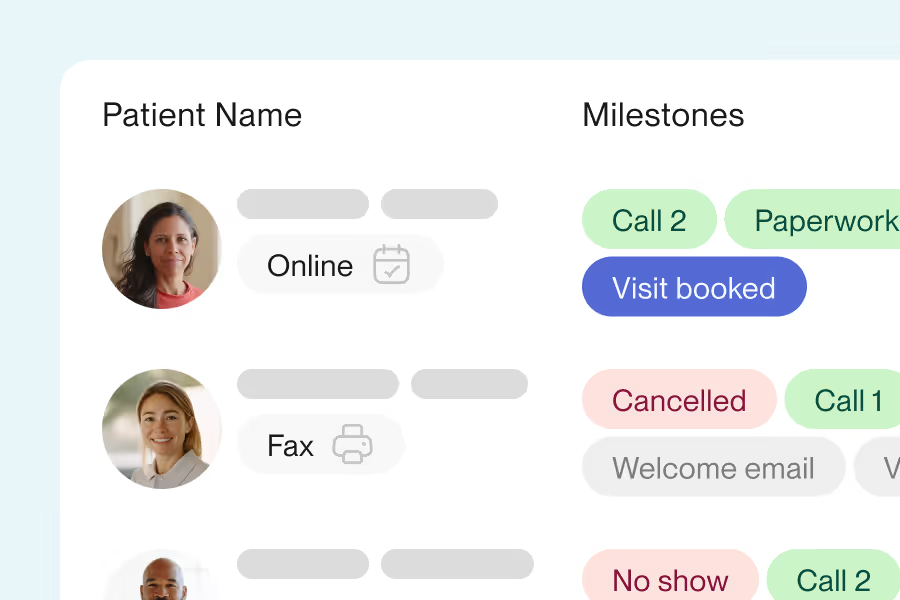
Um, so as a, as somebody at the therapy site, you need to be checking that faxing, fax machine. Likely, somebody, uh, is intaking that fax and typing key information quickly back in the chart as soon as they can so they can get that referral done. Um, sometimes that happens ideally, uh, before the patient is there, but if the patient has called and scheduled their appointment, um, you may be working, looking back at, you know, a week's worth of faxes for, um, advertisements and everything else that's come in via fax to find that patient's chart.
Um, and then, you know, or a PT is coming in the office and saying, "Do we have Brenda Jones's record? Is this something that, you know, you can get?" And so you're frantically searching for that. Um, when you finally find it, it is, did they send you everything that you need? Um, hold on. The referral from s- to surgery in the first place came from a PCP that's on the different system.
Do we have their record and the history of what was tried before they went to surgery, and what, um, some of the details that PCP named? No, we don't have that. Do we call their HIM department, or do we do therapy without that information? And then flipping through those fax pages again, do you have the right progress notes that you need?
Do you have the right procedure notes to know exactly what you're doing with that patient? Um, that often takes hours and hours in order to do. Um, so finally, hours later, you've, you've got that. You've [00:22:30] seen the patient. Um, you've done the right things for the patient. They've, they've improved. You need that plan of care, uh, and you need to get that, uh...
And before that even happens, you're just need that plan of care even signed by the physician. So how are you getting that back over? Well, you're probably faxing it. That physician is still getting, uh, a lot of details and a lot of, uh, faxes from other groups, plus, uh, you're, you're getting those junk faxes.
We all get them, um, in, in healthcare. And so they're gonna have to dig through, and the, the, the admin person at the physician's office says, "Well, y- you didn't fax it to the right machine. Can you fax it to the machine next to me?" And that's not a number you have. And so you get in that argument. And so all these thing, different things happen because that's not digital.
Um, and so then progress, results. How do you send that back in a way that the, the referring clinician can understand that and have that two-way communication about how the patient's getting better and what more they need in the future? Are those going back into the chart? Is somebody inputting that back into the chart on the other side?
Maybe, maybe not. Um, and then I think Lynn made a really good point in chat as, as Therasa was talking about prior authorization and some of the other administrative workflows that go into this. So you get the request, uh, or you, you wanna proactively get that prior authorization. The patient needs six visits.
Um, so you're collecting evidence in the chart, and then you're sending a fax to Evocare. Um, then whoops, the payer didn't mention these pieces, four pieces of information you [00:24:00] need. Now you have to dig through fax again, get on the phone, um, and then meanwhile, the patient's sitting there in the middle of all this saying, "Can I have an appointment?
Can I have an appointment?" No, you can't have an appointment for, for three months because we're working through all the administrative details of it. Um, and the Gen Z patient, bless them, will think, "In the big 2026, how is this happening?" Um, and so all of these workflows really just frustrate the provider and, and patient.
Best case scenario is that it's frustrating, and worst case scenario is the care just doesn't get done
Marla: Yeah, and I, I mean, you mentioned the fax machine and the fax, and even some people say, "Oh, well, I have an electronic fax now." But that's still just a PDF that you have to download and upload, and it's still not information moving and exchanging.
So I think that's a really good point, and like you said, Lynn, Lynn recognized it's not just that fax part, but it's being able to communicate back and forth with the doctors, with the providers, being able to share scheduling back and forth, and billing back and forth for those groups that, that want to even communicate inside their systems with different EMRs.
So I think that really great, great points that you made. Um, what would you say is the biggest issues for our own operators and our businesses and our patients? Like what does that mean in long-term of terms of what a clinic owner actually has to spend extra time and do that it should be unnecessary and wasted?
Matt: It re- yeah, I, I... There's [00:25:30] just a couple of them, but I wanna p- point out, uh, them specifically. Number one is that manual entry of data and trying to get communication within your own office based on pieces of paper or a PDF that comes in, as you mentioned, Marla. Uh, that's not necessarily tied to a particular patient's chart.
You're not gonna have access to it immediately in your own workflow, and so you're just spending extra time in the day not taking care of patients and not billing therapy minutes. Uh, you're spending time actually just doing the administrative work of something that you might not necessarily need to do.
Um, best case scenario, and unfortunately this is the best case scenario, is that your clinicians and your patients are frustrated by the fact that, you know, there's just so much time spent, uh, literally reading paper or reading electronic versions of paper in order to get the information they need. And scheduling things, uh, two months in advance now becomes six months, the, when the patient really needs care today and really needs therapy today.
The worst case is something just goes wrong because we, uh, don't have all that data. Um, uh, the therapy, and I, you all, and I know you know this, but I just really respect the fact that therapy is just much more of an outcomes-based type of treatment than a lot of providers provide. And so you are always at the bleeding edge of needing to make sure that, you know, the patient is improving, the patient is progressing, and how can you possibly do that without all of [00:27:00] the information on the patient?
That's the table stakes part of this that we need to really solve, and the fact that the patient is gonna get frustrated because, you know, they were approved for three visits, uh, instead of six just because all that information wasn't electronically available, um, to the payer in order to approve that.
And so now you're on the phone going back and forth. Just so many problems that come from this, um, and many more even that you mentioned, Marla, that, that can be solved, uh, with electronic exchange
Marla: Yeah, and I think that a lot of people say, "Okay, well, we think about what is the cost of disconnection?" Most people say, "Well, what does technology cost?"
But we really should be asking what does staying disconnected cost? It's the staff time spent chasing information, like you said. It's the clinician trying to piece together a patient's history. It's the patient filling in gaps between providers. It's potential delays and referral leakages, and it's the strategic cost of not being able to do partnerships or opportunities with other health systems and ACOs and the infrastructure that can support that so you can share outcomes back and forth.
So let's shift from the problem, 'cause we, gosh, we're all feeling it every day. I, I think everyone here said couldn't agree more. Um, and let's shift to what's actually possible today. I saw a great question saying, "Well, when will all this be implemented?" That's the great part. Um, Therasa, can you tell us, uh, what's possible right now in terms of information that can move electronically from rehab organizations, [00:28:30] hospital systems, that people don't even realize is actually happening right now?
Therasa: Uh, you bet. First I want to comment on-- I felt like I was on a front row of the, of the Twilight Zone listening to Matt describe ... I mean, if we take a second, just really think about it. Like, when we describe what happens in healthcare today, in no other industry will you d- sit here in a, in a webinar talking about that, right?
That's, like, unheard of. So just take a minute and enjoy the front row to the Twilight Zone. Um, this is wh-what's possible today. Uh, and then I, I can't wait to talk about what's possible in the future. Um, what we have built, as I mentioned in my comments, what has been built out and what continues to be refined is the national infrastructure.
So what does that mean? That means that anywhere you have data flowing today-- Now, today it may be flowing over the fax machine, a phone call, a portal, through the patient. You know, there's different ways that data flows, right? Let's, let's look at it as a flow. Now moves over the internet in a secure way.
And what does that mean? It means that a referral comes in. The pat-- The, the providers that are sending referrals from within their EHR have the ability to send a referral electronically out of their EHR, send it like as if it's an email, a, a secure email that can go to a, a PT or a PT office that you were able to find in a national directory and say, "I'm gonna send this to Marla."
And Marla's gonna receive this referral [00:30:00] within her EHR, so Prompt, and be able to look at all of the clinical data. So what clinical data is available? It's all surrounding what they call the USCDI. So the US Common Data-- Well, d- Matt can keep me, keep me honest there. It's basically a lot of clinical data
Everything that you could ever imagine that you'd want on a patient. So you have the demographics on the patient, you have the payer information on the patient, you have the common, you know, problems, allergies, medications, the most recent procedures. You have labs, you have social information, and the list goes on and on.
All of the data that you probably get a course out of that data today. Now imagine being able to get the profile on the patient, not only from the referring source that you, you got that record from. You can choose to go back out and query the community to say, "What else can I know on my patient? What else?"
I can get a three sixty view of my patient, maybe from their behavioral health provider, as long as it's not secured down. Maybe you get information from, uh, even their dentist, from their vision provider. And that data set, that data set with AI placed on top says, "Here's a really good summary of the patient, the patient's story.
What have they had done recently?" So imagine not only being able to draft a care plan around I know my patient, I know why they were referred here, here's the outcome I'm looking to get to, but also a very personalized experience. So you can now talk to your patient about, hey, you can... It, it feels very personal and I, I can relate it to a [00:31:30] personal experience that I had on that.
But you also have the ability to send information back. So now electronic cares- care plan signing, the ability to communicate and share information back, not only again with that referring provider, but maybe your, your patient has an accident on the weekend and they go present at the emergency department.
Shouldn't they know about their physical therapy that they're going through? Shouldn't that ED doc know? And now they'd be able to get to that on demand, be able to pull that, that patient's care plan, their progress notes, where are they at in their therapy, and be able to administer care in a much more intelligent way, sitting bedside with that patient.
So the list goes on and on. Anywhere, I always say emphasize, anywhere data is in motion on that patient now can be moved electronically and be able to communicate electronically on that patient. So the, kind of the world is your oyster on what you would like to do and as we move forward. Prior authorizations, you follow up with workman's comp, you name it.
That's where data is at and where data will be, uh, for these particular patients.
Marla: Yeah, and I, I really kind of think back to when I go to a doctor and they give me a script for a medication, and it goes right to that. I say, "That's my pharmacy right there." They click, it goes right to the pharmacy. I show up and my medication is ready.
That's called that direct messaging/exchange where we now have that capability in rehab and it's not just a PDF version electronically, it's actual information being inserted into the system and shared back and forth. And now that we have those endpoints on both sides, you can do that in many [00:33:00] different ways.
So I think that's a great way to explain it. And, um, Therasa, I know that, that there's lots of EMRs, you have these data points, and not every EMR is taking-- able to take full advantage of this infrastructure. So what's different about No2's integration with Prompt that excites you about what the two organizations are building together?
Therasa: Well, first I'll start out with what I consider to be the modern mentality of Prompt. Um, and that creates both from a product, Jack, shout out to you, uh, from a product perspective, um, from their leadership perspective, is that they're very much of a modern organization, and data, AI data at scale really has dictated their roadmap on how they integrate with Kno2 and bring data into the experience.
So, um, sometimes we can work with partners where interoperability is a-- I always say it's a noun, so it's a checkbox. They may sometimes even have a button that's called interoperability in their EHR, and that is, like, not good, right? Not a good experience. Don't make your providers go hit a button to go find something, to go look at a record, and basically what you're doing is taking the fax and making it electronic, right?
That has not been the experience with Prompt. So as Prompt has, has continued to build and continues to build out interoperability, it's become a verb in their, in their platform. So now I assimilate that patient's record. I don't, I don't have to hit the interoperability button, right? It comes in. All of the actions to exchange the data are hidden behind the scenes, and you get the experience of the data exchange and the data within the patient's record.
[00:34:30] Conversely, um, you all also will be a great participant with the outside world, 'cause it's not all about you and not all about the rehab provider, right? You wanna have great referring provider relationships, and their ability to get to your records on demand from the Prompt EHR through their Epic system, through their Athena system, that's really important to being a good custodian and a good participant on the network.
So it's bidirectional, and that is absolutely the engagement has been with Prompt, and they're very thoughtful, I would say, and deliberate in how they design the experience, 'cause it's all about that provider experience and the assimilation of the data, uh, in, back into that, into that patient record.
Marla: Great. Thank you so much. And I think that's, that's fantastic because, you know, people have been saying, "When is this available?" This is available now. We, we are, we are have-- do have this out. We are getting this out to everybody. Um, and Jack, that's where I really wanna transition to you to make this more tangible because, um, connectivity is only valuable if it actually becomes part of the workflow.
So if you can explain to us and walk us through what Prompt is built with Note2 and what that experience now looks like inside the EMR for a Vieve organization when they add the Note2 connectivity on it.
Jack: For sure, and thanks Marlo. Super excited to talk through this one. You know, so as Teresa and Matt, you've set, set the stage really w- really well here.
Um, but really from my perspective, I think of Note2 as this sort of like data pipeline that moves data in and out of Prompt. And Prompt, of course, is, you know, where the [00:36:00] work actually happens, right? Thinking about it from a clinics perspective, you know, you have your therapists in there, you have your front desk team, your billers, and Note2 is kind of this like transport layer underneath all of that work, so you don't have to go outside of the EMR.
And, um, you know, I think that's really great as far as like work- from a workflow perspective because it doesn't mean that you have to sign into a different system to, to get the data that you need and, and for most features. Um, so I'll be a little bit more concrete about what we've actually built here.
Um, and then also walk through a little bit what, around what that unlocks. So the foundation of all of the features that I'm gonna be talking through is gonna be this concept of direct secure messaging. You know, Matt, Therasa, you've alluded to that as well. It's really like this transport layer for sending and receiving data that's content, content agnostic.
So it can essentially carry any file type. But the primary file type, um, that unlocks a lot of the automations that we've built is a r- is called a CCDA, which is, you know, you mentioned US- Therasa, you mentioned USCDI previously. That's what sort of the information inside the CCDA is based on. And at a very, very high level, that's basically just a machine-readable document type that has structured data and labeled fields that other systems understand easily.
And so what we've built in, on the Prompt side is the ability to create a CCDA, so generate those types of documents and send them out to out of Prompt, as well as built the ingestion for CCDA, so we have the ability to ingest that type of data, um, coming from the other direction. So when it arrives in [00:37:30] Prompt, our system reads it, it pulls the structured data into the system rather than just filing an attachment onto the chart and having a human manually review all of the data associated with that and keying that data into things like fields.
So, um, we built that direct secure messaging flow using existing patterns today. So everyone's familiar with eFax. The direct secure messaging flow in Prompt looks very similar. It behaves almost identically. So there's no relearning of critical workflows here. Um, you would just be able to turn that on and, and follow the same patterns that we do for faxing today.
Um, I also note that Note two also covers unlimited faxing, so that's a nice side by side where you can actually do both at the same time. Um, and why does this matter? So, you know, everyone has alluded to this already, but like for a very long time, referrals have just been a picture really, like a PDF, um, and someone on the team has to go and parse that information out.
It's very labor-intensive. Um, so now that we have data in structured fields, we can trigger automations downstream of that. And I'll give you an example of how that's working today for a client that we have a, an active pilot for. Um, so to set the stage, this is for, um, you know, a large enterprise group, over a hundred and fifty clinics.
They see, you know, eight to nine thousand referrals a month from a hospital system or hos- hospital partner And what happens in the, the previous flow was that that hospital system would just send all the referrals that came in for therapy in a CSV. Someone on their team had to go in and, like, actually map all of those [00:39:00] individual referrals to the right clinic and location, distribute that work list out to all of their front desk team, which is really labor-intensive and manual.
And, you know, with that level of volume, things are just gonna inevitably fall through the cracks, right? It, and it's not a people problem, it's just like a volume issue. Um, and now that we've implemented these more automated workflows through No2, the hospital system now just sends all of that referral volume directly to a direct secure message, right?
Uh, to a direct address. Prompt is able to then read the patient's home address off of those referrals and find the closest clinic that is associated, um, you know, to that practice, right, within 30 miles. And then they'll drop the document directly into that clinic's queue. Um, and at the same time that referral is being routed, we're actually sending an SMS automatically to the patient, like, giving them the option to schedule online through online scheduling.
And so, you know, in the happy path scenario, that's even happening in the context of, like, their appointment, right? So we're, we're getting to them really quickly, right? And, um, happy path scenario is that by the time the front desk team, like, looks at that patient, sees the referral, the patient's already created, they have a case already created, the visit's already scheduled, and that's just really a huge time saver.
Um, and it just, it just again, it points to the, the larger direction of things that we're working on, which is like reducing manual workflows and continuing to automate more and more of these things. Um, yeah.
Marla: That's awesome. And I think I, I really wanna stop there for a second, that, [00:40:30] that not only can the information be sent over, ingested in, but it can be texted right out to the patient, so by the time they leave that doctor's office, they have that text, and they can schedule their appointment and schedule their visit.
Um, putting it in the hands of the patient, not letting them, you know... All life gets in the way, and they forget to schedule, and then a day or two passes, and we know what happens when patients don't schedule right away or they don't hear from you. They, uh, tend to not end up going. So that's fantastic. And then Jack, I know that's one way that we are sending and receiving information right now in Prompt, but what about the part about the meaningful information that you said Prompt can send back to the broader healthcare ecosystem?
Can you tell us a little bit more about that and how that works in Prompt?
Jack: For sure. Um, so I, I talked about what information we can receive and what we can do with that information. Um, you know, what we can send back, sometimes that part gets overlooked a little bit, but it's, like, equally as important because right now that's what creates this communication gap.
So we hear it from practice owners all the time, you know, it... And it's not for lack of trying on their end, but, like, when a referring p- physician refers a patient over, the really only way to, like, keep that physician in the loop is, has been manual workflows. And it's pulling, you know, the statuses of where that patient is, it's faxing that information back, which is a burden on top of all the other flows that, you know, our, our, you know, our, the, the users have to do today.
So the outcome of this is that the referring provider ends up without as much visibility into what happened to that patient and, of course, they wanna be in the loop. So what goes out in Prompt today, and of course we're continuing to make enhancements to this flow [00:42:00] and to make it as automated as possible, but what we have today is, you know, first we can structure clinical documents, right?
We have the ability to create those directly in Prompt. I talked about the CCDA documents. We can generate those and send them directly out. We currently have things like continuity of care documents, which is the full medical history referral notes, and we're working on extending the number of document types that we can support to include things like discharge summary, progress notes, things like that Um, and that matters a lot with large health systems, particularly because when you're using direct secure messaging, they heavily prefer that structured data over things like PDFs.
Um, you know, it's because there's a lot of data associated with that file that gives them more information to know how to associate it to a patient correctly. So it makes it easier for us to get that, that information over successfully. The second thing here is around the ability to find those direct secure messages or those direct addresses from the provider level.
So in Prompt, you have the option to basically look up provider direct, uh, secure addresses from providers specifically through the UI, and then that way you know you're sending the message directly to that provider, so it's a lot more targeted. And then the third thing here, um, and this is one that's coming down the pipe as well, but patients being able to take interoperability into their own hands, right?
So we're working on a feature called, like, the patient portal. Patient can use no-two, uh, integration to generate all of their records that they want, and then that way they can download it independently and take it with them as, as they go through the healthcare journey. But it also gives them the ability to send that function-- send that, um, message through [00:43:30] no-two to a provider of their choosing.
So it puts the sort of the onus and, um, it makes it more inde- uh, independent workflow for the patient directly. Um, and then another one that Therasa had already kind of covered, so I'll go over this really quickly, is the ability to respond to queries coming in from the network through TEFCA and care quality.
You know, Prompt is now in a position to answer record requests or queries from other systems automatically. So if a hospital system or another EMR queries, you know, the national network looking for a specific patient, we can respond if we have a patient match in our system. And that isn't really like a UI consideration for, you know, clinic owners or practice owners.
There's nothing that needs to be done. That all happens behind the scenes, so there isn't like a new workflow to learn there. But that is really important, um, and that is something that we're working on, you know, like really scaling out in the future, in the very near future.
Marla: Extremely impactful. I think that's so valuable.
Like you said, we want to be doing as much as we can with other organizations or even if you are in a hospital system and you're using one type of EMR, to be able to use another EMR specific for rehab so that they can really talk back and forth. Um, so with that, beyond referrals and clinical records, what other types of information have we built the groundwork and APIs to exchange between hospital systems?
Jack: Yeah. This is a- And- This is a great one. Um, and again, I just want to be really clear on what's, you know, live today versus what's on the roadmap. So, you know, what's live today, and these are ones that we mentioned, referrals coming in, clinical documents going both dir- directions via direct secure messaging, unlimited faxing, [00:45:00] automatic facility routing, um, working off of structured data, automated patient outreach, answering record queries, things like that.
Um, those are all awesome, but that's just, like, the tip of the iceberg really. I think, um, you know, I'll cover-- I won't be able to cover all of it, but the near-term stuff on our roadmap that, like, we deem as, like, very high priority would be, you know, one, finishing up that full end-to-end referral automation.
Right now, we can route the document, we can take some next steps on it, but we want to be able to parse, like, every piece of information off of that referral to create the lead automatically, to create the case automatically, to use that data even for, like, the initial eval, for example, like, as part of the provider workflow.
Um, I think that will really save time and really create additional opportunities for providers moving forward. The second one is sort of adding onto that, is that, like, closed loop referral flow that Therasa talked about earlier. So, um, basically being able to send statuses back to the referring provider in an automated way.
And closed loop basically means that at any point in the process, we can send a status back. So, like, did the patient schedule? Did the patient arrive? Did they discharge? Like, if we can send a message back to the referring provider where they are in the progress, but also send the document back as well, which gives them additional context.
So that's another workflow that we're taking off of, um, you know, prompt user's hands basically And then the third is being able to use that network query functionality directly inside Prompt EMR and automate it to some degree as well. So, you know, you know, being able to look up a specific patient [00:46:30] across the full network, um, even before they even, like, schedule a visit in the, in the EMR directly, right?
By the time they hit the platform, we have all that information about them. It's loaded into their file, and then that way you're not hunting down that missing information. The system is smart enough to pull that down automatically and associate it to the right patient. Um, really rapid fire. Beyond those, there's a whole bunch of other things on our radar that, you know, No.
2 has. They've built out amazing functionality and, you know, we're, we're working on getting those in as well. Um, you could think of e-signing, for example, through leveraging like a program like DocuSign through direct secure messaging. So, um, signing plans of care is-- becomes a lot simpler and, and, and it's automatically attributed to the patient.
Um, you could think about all of the automations that we wanna build on top of scheduling, patient status, uh, billing and, and outcomes too. I think outcomes is one worth calling out. Um, you know, because not only is interoperability hopefully improving outcomes for patients because there's better visibility across the system, but there's a lot of great outcomes data in Prompt already that we think is, you know, really gonna be useful in other systems as well that we can potentially share through No.
2, uh, functionality and patterns. Um, so I think there's just a lot of really exciting stuff on the roadmap, and we're, you know, excited to continue to develop against it.
Marla: Yeah, and this is really exciting, not only for rehab groups, um, outpatient ortho clinics, but, but those orthopedic groups with rehab service lines.
I think that this helps to understand that now you can utilize an EMR that is rehab-specific, that can communicate with your hospital system [00:48:00] EMR, and that whole system doesn't feel disjointed, disconnected. Um, and you did talk about outcomes, which I think is super important. Prompt has definitely invested a lot of time in developing out our outcomes strategy and platform, which is part of Prompt now.
No, you don't have to pay an additional cost at all, and that's because we really feel that as we get this interoperability and connectivity, we can share outcomes back and forth, and that's how we're gonna show the value of what rehab is really doing, is to be able to seamlessly share those outcomes. Um, so with that, real quick, Jack, how does this connect to the bigger issue of the direction of CMS and healthcare and where we're moving, where this administration is really moving today, um, and some of the initiatives that we're participating in, such as the Digital Health Pledge?
Jack: Yeah, that's a great question. Um, so for the digital health pledge in particular, I just want to set the stage a little bit here. Um, you know, it's-- Just to, just to make sure that we're on the same terminology here. For context with the group, it-- this is a CMS-led commitment. Um, it's, it's optional, but we have committed to it.
Um, technology vendors, EHR vendors, providers, networks, payers, they all come together to commit to actually making patient data move rather than just making it, you know, making the system technically capable of moving it. Um, so we signed the pledge earlier this year. We're on the CMS's published list, and actually, I think we're one of the only rehab therapy-specific EMRs on that list, at least at the time of signing, so we might be the first one.
Um, Marlee can [00:49:30] fact-check me on that since I'm not entirely sure, but I think that might be the case. Um, the backdrop here is that CMS has been actively breaking down a lot of these barriers to interoperability, especially with the current administration. Um, so compliance and security requirements, of course, are, are gonna be there, right?
But it is getting easier and easier than ever for networks to connect to each other and for different systems to talk to each other. So, um, you know, and that is due to a lot of the work that the Teresa and the no2 team have been doing as well, since you guys are really at the frontier of that. Um, but the clear direction that we're seeing is that we're moving towards structured data, not away from it, right?
We're moving away from fax and manual-based, uh, methods. We're moving more and more to automation. And there's two-
Marla: Oh, is that Jack, you think? Who
Matt: Yeah
Marla: Okay ... he froze. Yep. Okay. There's two.
Therasa: There's two. Two and two.
Marla: Um, I think he's gonna be talking out a little bit about how now with the digital health pledge, you know, we're really trying to make it so that not only is there interconnectivity throughout all these hospital systems, um, but also that there is gonna be a QR code that you can scan and all your information is shared back and forth.
That's the kill the clipboard. So, uh, really important that- And- Yeah ...
Therasa: Marla, I can, I can round out some- Okay ... of the things that Jack was saying. Uh, since we're sitting at the center of it, one, um, wanted to comment on that, that Prompt has taken the full pledge for an EHR vendor, um, in CMS, which is really, really important, [00:51:00] and critically important to the rehab space.
Um, but two, the, the secondary part of that is the ability to engage at a national level. So by the participation... So keep in mind that No2's been doing advocacy for a long time. Um, but at a certain point, our voice became meaningless or becomes meaningless until we have the participation of the EHR vendors in rehab.
So thank you Prompt for that. Uh, and really, really putting in and leaning in on that. Um, and then secondary is the participation by the rehab providers themselves. Uh, until you have that full thing, we really can't influence the national network. So what you guys are doing in CMS, um, and obviously CMS can move the needle, as we all know.
Anybody that has, uh, dollars associated it, with it is gonna move the needle. Um, and we're seeing huge participation on it. So, um, what Prompt is doing is, is fantastic opportunity. The other part I wanted to touch on that Jack had mentioned is coming is that ability to query between providers, right? So Prompt making, being able to query out and having information being able to que- be queried of by your referring providers.
That also includes patients. CMS is very, very focused to the patients being able to access their records. Um, and by participating in CMS, Prompt is also committed to giving the patients their information that they need, uh, because we know everything's consumer now, right? Everything's being driven by the consumer, so they're really putting you in that position.
I would say just when I say you, the rehab providers, Prompt is doing a fantastic, uh, future [00:52:30] positioning and current positioning to put you guys on the leading edge, uh, to where things are at with interoperability. Sorry to interrupt you, Marla, I didn't mean to.
Jack: I, I'm back by the way. Sorry about that. Hey, Jack.
My internet line cut out intermittently. Like, you know, live, live calls, like anything happens- ... so, so, um. But yeah, thank you- I put my jacket on, Jack ... for, for, you know- Yeah ... taking the second half of that question, moving that along.
Marla: Yep. Teresa did a great job explaining. Thank you so much. And, and like you said, it's because of the foundation that you guys have set at No2 to be able to take and ex- and take all of this and then be able to do that.
Um, and Matt, that brings me to the question for you is, how does this ultimately change rehab's ability to participate in health system partnerships, ACOs, and value-based care? 'Cause that's the big picture. You know, that's why we're doing this, so we can literally be one health system unit, not these siloed, uh, care pr- Pa- plans
Matt: Yeah, and I think from a, a risk sharing perspective or a clinically integrated network perspective, it's extremely important.
Uh, in my past role, I did work for a health system type of EMR, um, and we were tasked with trying to bring all those groups into a CIN, including therapies, and one of the things that we heard from major health systems pretty unanimously was, unless they're able to participate and exchange data at scale like this, we're not gonna ask them to join, quite frankly.
And so this unlocks for you a lot of different resources in terms of the future of how, uh, healthcare is built. And it seems to be, at least, uh, from the health system's [00:54:00] perspective, table stakes to be able to do this because this is leaning so much into proactive care versus reactive care that these folks are really gonna have to keep track of how rehab is going, outcomes within rehab, things like that as the patient moves it along in the process.
And without that, if you have, uh, ABC clinic or ABC Therapy that is participating and participating in things like care quality, Tough Gu- and direct messaging, um, they're gonna have much more of a stake and much more negotiating power within those systems than a group that is still doing things by electronic fax.
And so it is becoming more and more the, the, the lowest bar is that you're already doing this today
Marla: That's perfect. Yep, I, I 100% agree with you. And Teresa, I don't know if you want to answer that question as well in terms of just bringing us back to the big picture. You know, what does this do for rehab in the position of healthcare, and what do we risk as a position, as a profession if we don't move in this direction?
Therasa: Um, well, I'm gonna start with the latter part is, uh, obsolescence. That's what you risk. A- and that, that's real. That's not a threat, meaning it is a, it is an expectation of your referring providers. It is an expectation now of payers. It is an expectation of the patients that you are sharing data and sharing data at scale.
Um, the healthcare industry, like I said, we're sitting in the front row of the Twilight Zone. We're, we're catching up as fa- fast as we can, you know, to get this done. Um, I often get asked the question is, is paint what the future looks like, and my, my statement is is, what do you want it to be? [00:55:30] Like, literally, what, what do you want the future to be?
'Cause you, rewind the clock, and I always age myself in these calls. Rewind the clock to when, you know, the inter- internet was starting, and then you fast-forward to what you do on your mobile phone every morning, right? You, you scroll your mobile phone. You may catch a ride on your mobile phone. Uh, you look-- you, you do maps on your mobile phone.
I order food on my mobile phone. Would you have predicted that 15 years ago, 20 years ago? No. That, that's the whole intent, that once you get data moving and, and things are doing things at scale, it's like the world literally is your oyster. We have got to create this world where data's moving, and then you can move into different care models.
We can move into virtual care. We can start connecting to the home. And, and it just changes. So paint the picture like you want to, and the fundamental is that data has to move, so we've got to get started around that, and we gotta get-- we gotta push into that.
Marla: Perfect. Perfect. And I know we've got a couple questions coming in.
Before everybody, um, we start those Q&A, we're gonna put a little survey up so that way if you do want to connect more with Prompt, um, with, uh, Knoa2, learn more about Prompt outcomes, want to connect with Teresa or Matt, please let us know. We will make sure to reach out to you and connect you to the right individual.
Um, so if we didn't get some of your answers, questions answered today, you can do that after this call as well. So just fill that out. That popped up. And I'm gonna ha- just take a few of these. Some are really, really good. Um, Jack, this one is asking, um, [00:57:00] "When will the integration with Knoa2 allow a patient chart to be created automatically?"
Jack: Um, yeah, so sorry, I missed a, a little bit. Patient, patient appear automatically or patient rate?
Marla: One, uh, allow a patient chart to be created automatically. I- Yeah ... I believe it does create that, but I just wanted to go ahead and ask that.
Jack: Yeah. No, no, that makes sense. Um, and that's a great question. You know, that's actively on the roadmap.
Um, I can't really provide solid timelines on that right now just because, you know how software development works. Um, it's, it's very fluid. Uh, but you know, it is high up on the roadmap, and what we wanna do is not just talk about patient creation. We want to also create all of the corresponding, um, elements of the patient record as well, as long as we get that in as instruction fields through the CCDA.
So that would include, you know, the case even up to the point of, like, putting a pending visit in there and then making, um, additional information available as part of, like, the treat and flow, um, workflow as well.
Marla: Okay. Um,
Jack: and then- That is, that is, like, in the near term is, is I guess the TLDR.
Marla: Okay, great.
Um, and then it says, "You mentioned that No2 can read the patient's address and route the referral to the closest clinic's queue. How does that work if all of their locations share the same fax number?" Uh, and I think that you can explain that with the, with the email or what you call it, the direct messaging.
Jack: Yeah. So, um, fax, fax numbers are slightly different. They're sort of outside of the direct secure messaging. They, they're, they both off- No2 offers both, you know, fax number, eFax capability, as well as direct secure messaging. The way that flow works today is that it's when [00:58:30] we get the referral, it's parsing the patient's address off of it, and there could be a, a number of addresses on there.
And so there's fallback logic across of how we've implemented it. But it's looking at the patient's address, and then it's comparing it to the addresses in the facility book at, you know, in that prompt, um, site. So it can then determine, okay, where should this referral go to? Is, you know, this person lives closest or works closest to these specific clinics, and you'd be able to kind of set that logic as well.
Um, so it's not necessarily using the fax number. It's using dir- like, actual location-based logic to the, to the facility and that... Then it would appear in already assigned, that referral would appear already assigned to that facility. So they, that w- facility would see that referral come through, incoming documents would see that referral come through as part of the lead, that sort of thing.
Marla: Great. Great. And we have a few more questions, but don't worry, we will answer these after the call and get back to you via email since you've asked them in that Q&A. But thank you so much. I'd say that the biggest takeaway today is that interoperability isn't just about eliminating the fax machine, it's about removing the barriers that have kept rehab disconnected from the rest of the healthcare system.
And if rehab wants a bigger seat at the healthcare table, the rest of healthcare needs to be able to see where we contribute, and we do need to make it so seamless for the patient, the provider, the owner, and cut down some of those extra admin costs that we shouldn't need to be doing day-to-day, um, so that we can really focus on the patient and the quality of care.
So thank you so much to Therasa, Matt, and Jack for joining us today. And for all of you who participated, we really [01:00:00] are so appreciative you spent your time with us, and we're looking forward to sharing this feature with all of you. Um, and until next time, we will be here ready to, uh, help you out.
Therasa: Thank you, Marla.
Thank you.
Jack: Thank you.
.png)
.png)
.png)