





.png)
Transcript
Marla: Welcome, everyone, and thank you so much for joining us today. My name is Marla Ranieri, and I'm the head of Clinical Innovation and Clinical Strategy at Prompt Health. And we're really excited to introduce you to V10: what's new, what's next, and how to think about AI in your practice. This is gonna be a jammed pack session.
We'll cover the way we think about the industry and build for it. We'll cover what's already live in Prompt and what's coming next, and most importantly, how all of this connects back to the outcomes that matter most in your practice: stronger operations, better care, cleaner revenue performance cycle, and sustainable growth.
So just a few housekeeping before we start. We have a lot of registrants here, over 1,000, so we may not get to every question live, but we do have a Q&A button at the bottom. We really want you to put all your questions in there. We will try to answer them throughout the session as we go, and we will try to answer them at the end.
If not, we will absolutely have some of your customer success reps reach out. So please use that Q&A portion below. And yes, we will be recording the session, and it will be sent out afterwards via email. And today, you're gonna be hearing from Mike Dwyer and Adam Baliatico, our co-founders of Prompt, as well as Pedro Texeira, our VP of Engineering.
So before we jump in, we'd love to get a sense of who's here and who's in the room. You're gonna see a poll pop up on your screen, and we [00:01:30] just wanna know, are you new to Prompt or are you already a customer? And if you could take a moment to fill that out, that would be great. We do wanna make sure we are really gearing this presentation to you and hearing from you throughout.
So you're gonna see a couple polls with that. And now I'm gonna hand it over to Mike. He's gonna go ahead and frame how we got here and why V10 is such an important step forward for Prompt
Mike: Thank you, Marla. I can't believe that we had a thousand registrants. I-- Not too long ago, it felt like we had ten, begging people to, you know, hop on.
So I know there's a lot of people eager about what we're building, and I'm excited to getting into it. I just wanna quickly frame how we've approached building Prompt historically to date. Before we wrote a line of code, we learned that for practices to be as successful as possible, you have to keep schedules full, you need to keep therapists in seat, patient-facing delivering care, and not bogged down administratively, and you need to drive your administrative costs and your RCM costs as low as possible to improve margin and make room for the clinic to really grow and thrive.
We believed, Adam and I, from the start of Prompt, that if we built intentionally, we could be wildly successful at helping you drive the outcomes that we intended from the first place, keeping schedules full, [00:03:00] keeping therapists in seat, and helping you have margin. If we nailed the foundation, the chassis of the whole platform, where we touch everything, where we capture data thoughtfully, we can enable a system that could complete more work on your behalf and better inform the work that could not be fully automated.
That is what we've been doing for the past eight years. And with recent innovation in tech, version ten is the biggest step forward for us in helping you in more ways. So what does putting Prompt to work mean in practice? It means developing a system of action. A system of action from our perspective identifies and understands a problem or opportunity that's coming up in the practice, recommends what should be the next step in that journey, and then executes or automates that action for you with the guardrails and reporting to make sure it's hitting the intended objective from the start Let's make this tangible in terms of just an example.
Imagine patient drop-off is starting at one of your clinics, and we all of a sudden see a sudden spike in that. Historically, someone had to notice that. They had to investigate why that is happening. They had to decide what to do about it and then [00:04:30] execute that plan, all along the way making sure that that plan is being executed a month out from now.
There is a lot of manual effort in that process, and the outcome of that depends heavily on who is identifying that and who is carrying it out going forward. A system of action that we're building towards is-- it, it just works differently. It identifies the issue early. It understands the causes and patterns because it's seen it before and recommends the highest probability intervention to solve that issue, and hopefully all doing this automatically.
One of the biggest advantages we have in our seat after being in this for eight-plus years is we have visibility across thousands of offices around the country, millions of patient interactions, and the entire patient journey from them starting in your practice to the last bill. We're able to see patterns and see the interventions that lead to successful outcomes, but also what can also lead to a negative outcome.
And this allows us to essentially build intelligence into the platform, not based on theory or a hypothetical, but based on what's happening in the real world, in your region, in your state Tech is obviously a giant component of what we're trying to build here, but we're also trying to be not just your tech partner, but your true business partner in the [00:06:00] practice.
And something I'm most proud of in our company is customer success makes up half our team. We have clinicians, we have billers, we have practice owners, and their sole role is to help you get the value that we're pitching on these webinars, that we're pitching you, you know, in every interaction we have.
We've also launched a few free services that purely cannot be solved by technology. So please make sure you're taking advantage of Career Connection. Everyone in this call is hiring. The goal of Career Connection is to help you get more resumes to keep your clinic full and growing. Our student placement initiative, connecting with schools essentially so that, you know, clinicians can have rotations in your offices.
And we've seen in practice that it has been one of the best hiring funnels for groups. And then our executive business reviews. This is something we're trying to do at least quarterly with our groups, but where we pull data on your behalf and come into these calls with actionable insights on how we can move the business forward.
When the business reviews essentially surface something bigger, it enables our team to go deeper with you and solve deeper problems. We offer business coaching as well on growth, hiring, and margin decisions that tech alone cannot solve. We're trying-- Our North Star Prompt and our entire mission is to drive extraordinary outcomes for [00:07:30] healthcare businesses and their patients.
We're not trying to be just a tech vendor. We're trying to build solutions around every business problem you're having
Marla: Thanks, Mike. That was a great way to set the stage, and really beneficial to hear about what we're doing outside the industry tech-wise and inside the industry. And as we said, there's a lot to unpack, and we have a lot to present today. So you're gonna see another poll pop up, which is gonna ask you which one of Prompt solutions are you most interested in hearing about.
So please indicate that in here. Again, we really want this presentation for all of you, and we want to tailor it to you. So let us know what you're most excited to hear about and learn more. And I know that notoriously, AI has continued to be a hot topic. People have started to jump into AI not understanding fully what it is or where it's leading us, so that's gonna be a perfect one to segue to right now.
There are no better people in the industry than Pedro and Adam to talk about this, so I'm gonna go ahead and give it over to you guys to talk about AI and what we're doing and what, what AI truly means to Prompt
Adam: Awesome. Thanks. Thanks, Marla. And I think, you know, some of the points that Mike made, um, are really worth hitting home on. But, you know, we've been doing this now for almost a, a decade, which is crazy. Uh, we started in college, but, um, we've also [00:09:00] been doing it, like, solely focused on PT, OT, and speech. And I think what that really means is we've gained a ton of data and expertise in, in how those businesses run and, and, um, we've also built the data model to perfectly support those businesses.
Um, you can't actually shortcut, um, building a great data model, and you, you have to solve from the moment a patient finds your clinic till the very last bill is paid and everything in between. 'Cause if you're missing data or you have garbage data, you know, you can't build great automation. You can't build great AI.
Um, I think the other thing is also that, you know, the length of time we've been in the industry and how much we value security and compliance. Um, you know, we're 100% US-based. We go above and beyond to make sure that your data is safe. And, um, I think a lot of the companies starting up today, they, they either use a ton of offshore labor or maybe they're a little more fast and loose, um, when it comes to compliance and security.
And I just, you know, remind everyone, in, in healthcare, the penalties for being fast and loose with your compliance and security are, are astronomical. And I, I think it's a big risk in the industry right now is that there's... You know, one of the great things of AI is it's so easy to start, to start a software company, but it also means that some people that might not be in it for the right reasons or they take shortcuts, um, you know, and they just think about, "Oh, we can build this fancy thing that seems great," but they don't do all the other work that is really required to protect, um, [00:10:30] you know, healthcare data and how important this data is both to you as the practice owner and to the patient, um, who really owns the data as well.
Um, so I think, Pedro, if you have anything to kinda add there, maybe about how we think about AI and how we're approaching, you know, both AI and automation. It'd be great to kinda touch on that.
Pedro: Yeah, happy to. So I think one of the nice things is Prompt, you know, built as a system of action, right? And action, why do you take action?
It's to get results. And so I've been doing this now for well, I actually coded, uh, some of my first, uh, machine learning models back in 2009. Uh, and clinically trained, uh, went through a whole research phase, um, and got a PhD. I guess that's a little bit more than a phase. Um, but you have to, in that complicated environment, track the data.
You have to be really rigorous in what you're doing to actually get real results. And I think the best way to cut through the noise is if you're taking action and getting results. 'Cause you can say a lot of things, and you can make a demo or a prototype really easily, but then actually getting to the point where you're getting real results is hard.
And at this point, Sidekick, Insight, all these different AI models that we've built over all these years have handled and helped with over 100 million visits. Uh, and I think the, the results then kind of speak for themselves, right? We get results. And so when you're working with a partner, it's nice to see, do you actually get results?
And I think that's a key question everybody should ask is like, how, you know, how do you know this works? How do you get results? And we work very hard to be rigorous so that, you [00:12:00] know, step one, step two, make a prototype, you know, looks easy. But, you know, at step 10, how did you get there? How did you track it?
Can you see we have a lot of analytics? You can see Sidekick usage, for example. You can see how people are getting their results. You can drill down, you know, when we give you a compliance score to see what's driving that compliance score. And one, because we had to track things to be able to make sure that we made AI that works and works at scale.
Uh, but also because if you don't understand how things work and how you got a certain result, um, you know, where, where the, the system's going, you know, perhaps, uh, to be a little bit suboptimal, it needs to be improved, right? That's how you get to the really high-quality thing is to be rigorous, to have analytics, and to work with somebody who will show you.
Like, you know, here, this note is the one that we thought, you know, maybe could be improved and why. Here's the part of your score, uh, to improve. Um, and here's the Sidekick result, right? So as folks are, are thinking through different parts, uh, uh, and, and evaluating what they want to do, I just really wanna point that out 'cause again, it's easy to do a pretty prototype or pretty demo, but actually getting something that works in a very, uh, high complexity environment of healthcare, like, that's really hard, and you wanna have that data.
You wanna have a partner with experience there, where they've been building, uh, over many years on things that compound from the clean, organized data foundation that we saw when we were actually meeting you all many, many years ago and were impressed by, uh, all the way to now. We've gotten to build in and integrate that AI and now can attack things like scheduling patient flow, RCM, you know, in addition to the clinician workflows that, you know, back when we, we had the PredictionHealth days, we were [00:13:30] so familiar with.
So results are key, and I think at the end of the day, that's the thing that cuts through the noise.
Adam: Yeah, I think putting some of the results up on the screen. Um, I mean, importantly, we're not gonna sit here and tell you all of the results are from AI. Like, I, I think any company that comes there and says, "Hey, we're driving all of these results with AI," like, that's just not true.
Um, a lot of this results are built through developing expertise in the problem, working with our clients and saying, "How do we best solve this problem?" Um, sometimes AI is a great tool to solve a problem. Like, I mean, think about clinical documentation and converting a bunch of text into structured fields to populate a note, like, needs AI.
But solving plan of care compliance and reducing patient churn, like, I mean, we've been doing this since 2019, and they're ... You know, we've made the things marginally better with some AI, but they existed for years and delivered great results, um, without AI. So also, you know, a cause of skepticism when companies say, "Hey, we're solving all these problems with AI."
Like, I mean, I would ask to see those results and, and see them across more than a sample size of one or a sample size of 10. Like, for us, you know, we're really proud of this data. Our job, like Mike said, is to be a true business partner and, and, you know, for patients, I think, you know, again, Mike and I started this as patients, but, you know, we've seen across our entire customer base on average a 20% improvement in plan of care adherence.
And, you know, what does that look like? It's, you know, an increase in revenue for [00:15:00] the practice while delivering better clinical outcomes. You can see the patient NPS of plus 93. You know, schedules are running at 92% full. You'd think, oh, my provider churn's gonna go up because they're busier. But you know, what you actually see is we have 35% lower provider attrition and 75% less required documentation time, even though the therapists are doing more notes.
Um, so, you know, we're really proud of these results and just looking to continue to drive them, um, forward every day so that, you know, clinicians, billers, admins, patients, and owners, like, those are our five users. They use our software every day, and we need to keep optimizing the outcomes for each of those users, minimize the amount of time they spend in our system, and maximize the clinical and, and business outcomes that can be driven, um, in partnership with our clients.
Marla: And that was a great point, Pedro, that you made earlier about that it- we're becoming a true system of actions for practices and that the data and the results are really what should help stir you and inspire you to utilize AI and, and good AI, looking at the difference between the two and how can AI really help your practice.
It needs to deliver ROI. It needs to deliver results. So that's a great way to look at it, is through what has been happening so far in the past. And we're not done yet. As you know, we just released a ton of new features. So that's- I'm sure you're all excited for the meat and potatoes of what we're gonna present today.
So before we do that, one more poll asking you what you're most [00:16:30] interested to see today in these next few slides. Um, and of course, we are gonna jump right into that and tell you about what's live, what's actually out, not just theoretical, what has been released. Many of you have seen it probably in your Prompt University, but there's so much we want to really walk through a lot of this with you and then go ahead and make sure we continue to tell you about what's coming next.
So with that, I'll pass it along back to you. Adam, tell us a little bit about what's live
Adam: Awesome. Thanks, Marla. I think, um, the first main feature we've launched was actually in our, uh, clinical sidekick, uh, about a month or two ago, we launched our s- objective data insertion. Um, so what does that mean?
Historically, when the therapist would talk to Sidekick, um, all the objective data would populate into one free text box. And, you know, that's great and it saves time, but, you know, ultimately, one of the reasons we built all the structured data was because the therapist liked having all of that range of motion, strength, special test data in the actual fields.
And now, as you can see in the, you know, the GIF below, like with one click, all of that data populates those structured fields. And, you know, as we start thinking about Prompt outcomes, what does that mean? Well, that means you're gonna get graphing about their progress on these metrics. It means you're gonna be able to produce reports that say, "Hey, here's where you were as a patient at the start, and here's where you are at the end."
So this has been a great feature. Um, I think we've rolled it out, Pedro, maybe to half the Sidekick users now, and, and the [00:18:00] rest of them will be, you know, rolled out pretty shortly as well.
Pedro: I know we have well over a thousand people, uh, already using this every week. Uh, and they've, uh, got-- given us really rave reviews.
I know this was a, a classic request we would get for, uh, for folks. They wanted it. It's obviously a lot of clicks and things. It's a great area for Sidekick, and it was one of the, um, key items we were super excited to get to build right into Prompt.
Adam: Yeah. And maybe you could talk now about the, uh, the Ask AI, um, the clinical Ask AI as, as well.
Pedro: Yeah, of course. Um, so, uh, again, we like to, uh, meet folks where they are and, and deliver value. The structured objective data was a great example. And then Ask AI is another, uh, really, really great one. So, um, in the case that you've just done a visit with Sidekick, or even if you haven't done a recording yet, we have Ask AI, and it's available in mobile, which we'll get to in a minute, but also available in your classic little Sidekick widget.
So when you click to open it, you'll see that Ask AI, uh, button off to the side. And we've heard some of the folks' favorite use cases, uh, asking for things like, "Draft my letter of medical necessity," right? "Help me with a work excuse letter." But it also is able to see, uh, the information about the conversation that you've been having with the patient or the note content that you already have on the screen.
So things like looking for gaps. You know, did I have any red flag symptoms I should have asked for? Some newer, uh, therapists like to sort of double-check with things there. Uh, going all the way to things like, "Hey, you know, give me some feedback on my conversation with a patient." Where there's some topics maybe I could have visited from like a forming rapport perspective.
Again, useful for new grads. Uh, or, [00:19:30] you know, for the, the more experienced folks really pushing the boundaries, using it as a brainstorming tool. The Ask AI also a really, really great, exciting thing. Uh, if you're on desktop, uh, there's also a genius mode that you can toggle on, uh, which will increase sort of the, the horsepower, uh, if you will.
So you can ask even more complicated questions, uh, of it, um, again, with visibility into that patient that's currently pulled up.
We also-
Adam: I can take the next one. Um-
Pedro: All yours.
Adam: So one of the big, uh, features we released recently, we've seen a huge rise in like MSOs and multi-brand PT companies, and historically, a lot of times those groups would have to run across multiple instances of an EMR because they wanted to keep, you know, brand one separate from brand two, separate from brand three.
And so, you know, we set out to build a solution that would say, "Hey, we can still run our business from one instance," which for the executive team and the leadership team is great because I have one set of reports, one set of templates, you know, one set of rules. But each brand and each brand employee would only see, you know, their brand's data, and the patients in that brand would only see that brand when they go schedule online or, or whatnot.
So this was a big, um, a big enhancement for, you know, enterprise teams that have multiple brands and, and wanna keep that data separate but still operate from a single instance for all of the, the aforementioned reasons. And then another big, um, you know, shift, and this has really been, you know, as payer behavior has changed, um, if [00:21:00] we go to the next slide.
Um, you know, unit-based authorizations. You know, historically, authorizations were visit-based. You know, I'm gonna approve twelve visits for the next sixty days. And, you know, we built a whole tracking system around how to, you know, make sure we're getting those authorizations. But now a lot of payers are doing unit-based authorizations where, you know, they may approve, you know, twelve units of nine seven one one zero and ten units of nine seven five three zero and, and so on and so forth.
And we actually built an entire, um, tracking system to say, "Hey, here's how many units you have left of each CPT code." And instead of having to deal with this once it's a problem and once you actually get denials, we're able to now surface that information in real-time to both the therapist and the authorization team and say, "Hey, here's what you have left.
You know, still treat whatever your clinical judgment is," but it'll flag our auth team to say, "Hey, we need another auth 'cause we're running out of nine seven one one zero, and we know we're gonna do more ther ex." So this was a really robust, complicated build, and we launched this recently. And for, you know, a lot of these newer payers that are just trying to find ways to be difficult, uh, this was one of the ways that they were able to make things difficult, and this has really been a big step forward, um, especially in the pediatric and Medicaid settings, um, where there's a lot of this, and it's really prevalent.
Um, and then another one of the big features we've upgraded recently, um, we actually rolled out our AI intake platform about a [00:22:30] year ago, maybe eighteen months ago. Um, you know, and it's, it's actually now a patented solution, but it's the only intake platform on the market that is intelligent. And it's not just saying, you know, here's my set of questions or even here's my set of questions and I built basic branching logic.
What our AI intake does is, based on the information the patient's giving us, it's asking dynamic and intelligent, um, follow-ups. And it-- what that means is we're getting better clinical information and fewer questions. Better, more relevant clinical information and fewer questions. And for the therapist, if the patient's completed these five to seven kinda AI-powered questions, we can actually draft you know, 30 to 40% of the eval.
We've typically written a subjective. We have their medical history. We drafted an assessment, um, suggesting a few long-term goals and have the entire prior and current level of function already drafted. Um, so that means for the therapist, more quality time with the patient and less time kind of reviewing all of this and, and writing it into the eval.
And then in our most recent release, we did another round of model optimization and also optimized these models for pediatrics as well, um, which, you know, we're seeing there's such a demand for pediatric therapy right now, and it's, it's often been underserved, and we've been really lucky to work with some phenomenal pediatric teams to continue to improve and optimize the platform so that they can better serve, um, all of the kids that, that need therapy
Pedro: Mm-hmm.
So there's, [00:24:00] um, uh, other really great exciting requests we've gotten over the years. Uh, and obviously, as a therapist, uh, you may be in a lot of different environments. You can be very, very mobile. And one of the requests that we got was, "Hey, you know, like, could we have a mobile app? Can I record maybe not with my laptop?"
You don't always have a good place to put the laptop. And so, uh, I'm really excited, uh, to announce Sidekick Mobile. Uh, we, uh, again, have had, uh, many, many hundreds of therapists actually using this, testing it, uh, early alpha and, and beta users, which we of course as always appreciate. And we've been able to do a really seamless, uh, experience for it.
So for example, as soon as you open it up, you see your schedule, uh, for the day right there. Um, when you pull up, uh, then that visit, it, uh, Sidekick Mobile has the context for that case, which leads to even better results. And when you come back to your computer, uh, it syncs right back, uh, into that patient's visit, so you don't have to do any copy-pasting or anything.
You just, you're on the phone, you pick your patient, you can record it on this very mobile, easy-to-use device. Some folks even attach it to a microphone or something else, so they can just toss their phone into the pocket. Uh, some folks in a more quiet environment actually just keep the phone in their pocket and say they, they get great audio on it.
And then as soon as you're, you're done, you hit stop. And when you get back to your computer, the note just shows up right there. So directly underneath the subjective, objective assessment plan, uh, et cetera sections, the results are right there without you having to do anything else. And that seamless interaction is, again, another testament to getting to build something in, uh, directly as part of the Prompt team.
And we love cutting out steps so that you have as few things as possible to worry [00:25:30] about, so the folks can just take care of the patients Now, that's on the clinician side. If we go over, uh, to the billing side, uh, we get to expand now to a-another, uh, great offering, uh, which is, uh, and this is, you know, early, uh, process, but something called Billing, uh, Sidekick.
So Sidekick's been a, I think, a godsend, and we've gotten great feedback and testimonials about how much that helps when you're taking care of patients. Uh, but then, of course, billers have really hard, uh, work to do, uh, as well. And I like to joke that everybody deserves a sidekick. Uh, I loved superhero comics and stuff as a kid.
Well, you know, billers deserve a sidekick too. And so whether you're in Prompt or if you go to other spots, maybe you have to go to a portal to fill in information, uh, Billing Sidekick is another really, uh, exciting tool. Uh, with a single click, you can get a lot of information filled out. It's finding more and more, uh, all the time.
And, you know, eventually, uh, you know, the clinician still needs to be part of the visit. But for checking certain information, maybe for submitting prior auths, uh, you don't always maybe need to accompany, uh, your sidekick. And so future directions, uh, will include, uh, Sidekick going off to maybe do some tasks autonom-- uh, autonomously, uh, or basically agentically.
Uh, but currently already in workflow and helping some folks out, including our internal team of wonderful, uh, RCM team members, uh, to more rapidly get things done in the very complex environment of billing. So I'll pass it back to Adam for some other [00:27:00] really great stuff on our Command Center and Health Score.
Adam: Yeah, this is one of the things I'm most excited about. Um, last week we started the rollout, uh, to beta of our Insight 2.0, um, platform. And Insight 2.0 is a mix of analytics, our command center, a concept called the Health Score, and then a business coach, which I'll spend a few minutes talking about. But it's really the combination is a true game changer, and it goes back to, like, we have the entire ecosystem of data in Prompt, so we can do a lot of this analysis.
But, you know, historically, honestly, up until Insight 2.0, data was sitting there and it was waiting for you to analyze it. Um, and that's great. Like, we have a great data platform, a ton of ways for you to analyze it, but that also requires someone to analyze it. And there's so much data in a PT practice that you could never analyze all of it.
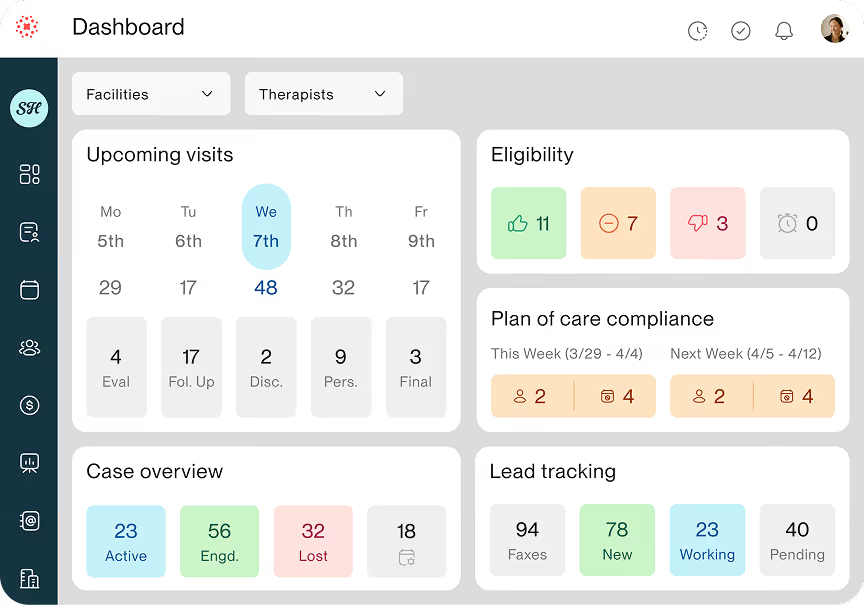
Um, so you'd say, "Hey, I wanna focus and kind of think about visits this month," or, "I'm gonna focus on plan of care adherence or clinical quality or collections." But, you know, now with Insight 2.0 and the command center, the command center looks at your data every single night and it says, "Hey, here's how you're doing.
That's the health score. You're eighty-four out of a hundred. You're in the green zone for, you know, collections. So actually, we're not gonna give you any recommendations about approving collections right now 'cause you'd be wasting your time there. But maybe you're having some problems with cancellation rate.
You're, you're in the fiftieth percentile on, on cancellation rate." So the Health Score is diagnosing problems and also diagnosing what you do really well. Um, I think a lot of times it's easy to focus on problems, but it's [00:28:30] also great to go to your team and say, "Hey, we're doing amazing at these things.
Like, let's keep it up. Here's what we're going to focus on." The command center and the business coach are your execution layer. They say, "Hey, based on this data- We need to try A, B, and C. And we've built the business coach, um, with all of our ten years of data and experience, our whole knowledge base. Our Prompt business coaching playbooks are built in there.
And then eventually, we'll also allow you to upload, you know, in a future version, like, "Hey, here's our practice guidelines. Here's our, you know, treatment protocols. Here's how we handle patient conversations," and continue to make that business coach and command center more intelligent and more personalized to your practice.
But, you know, this is gonna be a really powerful feature that allows you to optimize your business and just focus your energy where you need to focus it. Um, and you know, this is in early beta, but if you're a current Insight customer and you wanna get kind of bumped up the list, um, just shoot an email to support.
They'll, they'll move you up the list on the rollout. And if you're not an Insight customer, you can obviously reach out and, you know, we'll be rolling new customers out onto this over the coming weeks and months. But I just think it's a, a real game changer. And then if you go to the next slide, um, a little bit more on the business coach.
Um, it'll both proactively make recommendations, but then it'll also be like your real-time assistant. And you can say, "Hey, you know, great, you made this recommendation. Let's go deeper on that problem." The eventual goal with this is it's embedded [00:30:00] right in the EMR, and every user will have their personalized business coach.
Like, we know the staff therapist needs different recommendations than the regional director or the CFO. So the models will be optimized to give recommendations relevant to, um, each user as we continue to roll this out.
Marla: That was a lot. Thank you. And intentionally so. Um, what you just saw wasn't just one isolated product release, it's a set of updates designed to remove friction across the entire practice, clinical, billing, operations, enterprise, patient flow, and business intelligence.
And the best part about it is that there's AI not just taking away the manual tasks that you don't want to prioritize, but it's also helping make you better at your job and giving you the tools to do that and to really excel. So, uh, gonna put up a poll and ask you guys which of the releases we just covered are you most excited about.
My personal one is the Business Score and Insights 2.0, but we want to hear from you. And please note that everything we just showed you is what's live today, so you can utilize it, um, with your CSMs. You can help get this implemented, and you can utilize all of this today.
Adam: We kind of covered a lot really quickly. Um, I kind of want to circle back to some of what Mike said at the beginning. Like, when we started this company, we didn't want to just be a, a technology company. Like, we said our goal is to start with [00:31:30] technology, but then be a true business partner to run, you know, better, more efficient, more profitable businesses.
And every decision we've made for Mike and I from the time we started the company to bringing in Prompt Compensation, to PredictionHealth, to who we hire and, you know, what products we build is, is with that in mind. Like, we want to find the highest leverage ways to drive the best results for your business.
Um, we don't always hit the mark, right? Like, we've shipped features that maybe didn't do the thing we intended to, but part of why we built our company to be able to release thirty to fifty new features every two weeks is that if we miss the mark on a feature, we're gonna take all of that feedback. You know, seventy percent of what we build comes directly from customer feature requests, and we're gonna pivot, and we're gonna shift what we're building to make sure we're meeting the needs of our customers.
Um, like Mike said at the beginning, more than fifty percent of our employees are in customer service and, and product. And I think one of the most underutilized services is our student placement initiative and our career connection. Those are free services that Marla and her team actually run, um, to help get clinicians, and everyone knows the clinician burnout problem.
To go find burnt out clinicians and help them work at Prompt clinics because we know that Prompt clinicians are happier, they burn out less, they document less, and they make more money. Um, you know, so reach out to your customer success manager if you're not leveraging career connection. And then our student placement initiative, I, I think we place about thirty-six hundred students.
We're working with seventy-five universities. We cover the placement cost. Um, those are really great [00:33:00] services that cost you nothing. Um, the executive business reviews that we do are another service that's fully free. Um, your customer success manager will do an entire deep dive on your business and then meet with you and for an hour or two kind of go through all of that and say, "Hey, here's some of what we found that you're doing phenomenally well.
Here are some opportunities to improve." And then, I mean, if you do want to outsource your billing or to leverage our business coaching or some of our partners that do phenomenal business coaching, we have a ton of resources there as well. Um, continue to send, if you're a current customer, like, keep sending your feature requests.
Like I said, like my product team, I run the product team. They go through every single feature request. It, it drives seventy percent of what we build. And we can't thank you guys enough for the partnership over the years. Um, and I'm, like, really excited. I'm always excited about what we're building. But, like, the past six to twelve months and everything we're working on the next kind of six to twelve months is gonna be spectacular, and we can't do it without continuing to get Uh, feedback from you and, you know, again, as more than just your tech partner, we hope that kinda every interaction you have with anyone on our team, you know, that you're blown away with the level of service that you get.
Um, so just reach out if there was anything on this webinar that caught your eye or you really wanna follow up on. Um, if you're not a Prompt customer yet, reach out as well. Um, we're happy to talk more in detail about it and, you know, see if it's a great fit for you to kinda switch over to Prompt And with that too, we hope that all of these that you've seen today that's [00:34:30] either live or that's coming, that you thought, "Wow, I submitted a request for this," or, "I put in and I asked my CSM about this."
Marla: Because we listen to you. Everything we do is your feedback, which you guys are sending in. It's why we do these webinars today as well. We really do care about you who are in the system with the patients, with the payers, and helping tell us what we need next. So with that, I'm gonna roll one more poll about what are you most excited about that's upcoming.
Again, this is helping us pull our timeline and our roadmaps. We want to hear from you.
Adam: We appreciate everyone's time, and thank you again if you're a Prompt customer for being a Prompt customer and all the feedback.
And thank you to everyone, whether you're a Prompt customer or not, for taking the time today. We know you're all extraordinarily busy, so we appreciate it.
Marla: And thanks to you, Mike, Adam, and Pedro for coming live with us and telling us about all of the great features that are out there. And for all of you, look forward to seeing you on our next, next webinar.
Have a fantastic rest of your day.
Adam: Thanks. Thanks, everyone.
.png)
.png)
.png)