Switching physical therapy software isn't a decision practice leadership takes lightly, because not only do you have to figure out which option is going to meet your clinic's needs, you'll also have to get staff buy-in to make the transition successful.
You’ll want to make sure the tech you choose will support you in achieving your business goals. And while that could send you down a rabbit hole of endless feature comparisons, remember not to lose sight of the big-picture changes you’re hoping to achieve in your practice.
What are the top 5 benefits of Prompt? A quick breakdown
These don’t often present themselves as simple checkmarks (scheduling ✔️, documentation ✔️, digital intake ✔️). Instead, they’re the result of extremely thoughtful software developed with the intention of delivering larger, more meaningful benefits to your practice and the patients you serve.
Here, we’ve rounded up 5 big-picture benefits practices tell us they experience after switching to Prompt.
1. Better patient outcomes – AKA why we started!
This is going to sound obvious, but it’s worth stating clearly: Your practice exists to help people. Therapists are motivated to work alongside patients and guide them to meaningful progress. This means making sure that patients are fully booked, showing up, and experiencing real results. Prompt’s mission is rooted in helping practices help patients achieve better outcomes, through proven, purpose-bult technology. The goal: Build technology that makes it extremely easy for a patient to achieve success.
Patient attrition is a well-documented and established challenge in outpatient physical therapy settings. According to a 2025 study published in Musculoskeletal Science and Practice, no-show and cancellation rates in outpatient PT range from 10% to 73%, with potential revenue losses of up to 50.6%.
In practice, a mid-size clinic seeing 200 patients per week could be losing dozens of appointments to no-shows alone, and data confirms that every missed appointment is a missed opportunity for patient progress and recovery.
How Prompt helps
Prompt has a variety of tools designed to help you keep your schedule full and your patients on track. It’s not as simple as sending patients booking links (although Prompt does do that). It’s a systematic combination of features intended to help patients complete their plan of care and achieve demonstrated clinical outcomes. This includes being able to book and show up to appointment times they choose, receiving a provider’s full attention, and committing to progress without experiencing the unnecessary headaches cumbersome technology can cause.
Those features include:
Statistically speaking
- According to Prompt's internal performance data, Prompt helps reduce empty appointment slots by 30% on average, which means more patients getting the care they need each week.
- According to Prompt's customer data, clinics on the platform experience a 10% decrease in their lost patient rates on average.
- Practices on Prompt increase visits per discharge by 0.5 visits on average. (Ex: Before Prompt, each patient was seen an average of 9 times; after Prompt, each patient was seen an average of 9.5 times, which translates to more completed plans of care.)
2. Less therapist burnout
Clinician burnout is one of the most significant problems facing the rehab therapy industry today. According to a 2023 cross-sectional survey published in the Journal of Educational Evaluation for Health Professions, nearly half of PTs reported experiencing burnout. This peer-reviewed finding demonstrates the scope of the crisis across the profession. The APTA highlighted through its own research review that modifiable workplace factors, particularly documentation burden, play a significant and proven role in driving PT burnout levels.
When therapists experience burnout, both patient care quality and clinic reputation suffer as a verified consequence. Research published in Physical Therapy & Rehabilitation Journal (PTJ) confirms through systematic methodology that the physical therapy workforce is already operating at or beyond capacity, which means burnout isn't just a morale issue. The evidence shows it is a direct and demonstrated threat to the profession's ability to meet growing patient demand.
How Prompt helps
Prompt’s tools for therapists help them separate work from life outside of work by enabling them to document faster, without risking compliance. We worked directly with therapists to build a flexible note-taking process that allows PTs to finish notes as patients leave the building.
Prompt’s fast and flexible note-taking features deliver increased levels of happiness (dare we call it joy?). A few examples:
Statistically speaking
- According to the Reclaim Physical Therapy case study, the practice reported a 50% decrease in documentation time after moving to Prompt, which means therapists can now spend that time with patients or at home with their families instead of finishing notes at night.
- According to Prompt's customer survey data, 88% of practice owners believe their employees are either more or significantly more satisfied since switching to the Prompt platform.
- The evidence shows that 91% of owners believe their company is either more or significantly more efficient since switching to Prompt, a finding that is consistent with established best practice in healthcare technology adoption.
3. Reduced staffing challenges
The top challenge therapy clinics reported facing in our Q2 2023 survey is hiring, and the broader industry data confirms this is a systematic, profession-wide problem rather than an isolated trend.
According to the APTA 2024 Physical Therapist Workforce Survey, about 72% of PTs reported either a shortage in capacity to meet local demand or being at the limit of their existing capacity, which means practices across the country are struggling to find enough clinicians.
A 2025 PTJ microsimulation study using peer-reviewed methodology projected a national shortfall of physical therapist FTEs continuing through 2037, and the U.S. Bureau of Labor Statistics counted approximately 267,200 PT jobs in 2024 with continued growth expected.
Finding and retaining physical therapists, billers, and office staff requires significant effort (check out some pro tips here). Staff turnover at PT practices is a frustrating distraction for managers trying to focus on business growth and patient care. And retention's not the only problem, because sometimes your cumbersome software is both the reason you need more employees and the reason they want to move on.
How Prompt helps
Fighting with computer software on a daily basis can suck the joy out of working in a purpose-driven healthcare office. No one looks forward to staring at a screen, completing redundant tasks, and questioning why simple tasks feel cumbersome. The established best practice in healthcare technology is to prioritize ease of use and confidence in your system's capabilities, and that is exactly what the design team at Prompt delivers.
The result: a truly modern system that automates all the things that don't actually require a human to perform. Our goal is for you to spend as little time as possible working in Prompt, so we build highly efficient workflows to ensure that when you do interact with it, you can trust that each button clicked and word typed is actually necessary.
Easier-to-use software contributes to better retention rates when your staff expects to do their job with modern technology tools. It also helps with hiring, as many clinics on Prompt use it as a recruiting tool to attract top clinical talent.
Additionally, Prompt's front office and billing features reduce the need for the number of people in these roles to less than the industry standard. In other words, when your software does the things humans shouldn't have to do, you don't need to pay as many humans to do the same amount of work.
Features that retain staff and reduce the need for as many employees include:
- One-of-a-kind advanced claims engine that identifies proper and improper coding to prevent denials before they happen
- Automated claim posting that proactively identifies clean claims, posts all relevant cash and patient responsibility, submits secondary claims when necessary, and flags both full and partial denials for billers to work
- Automated waitlist and Plan of Care compliance scheduling automation
- Eligibility and Authorization tracking
Statistically speaking
4. Increased margins
Physical therapy practices face a pressing and well-documented problem: margin compression caused by declining reimbursement rates. According to APTA's analysis of the CMS 2025 Physician Fee Schedule, the Medicare conversion factor has seen repeated annual cuts, dropping to $32.35 in 2025, which represents a 2.83% decrease from the previous year. When adjusted for inflation, according to Beaming Health's industry analysis, Medicare reimbursement for physical therapy has declined approximately 30% over the past decade. In practice, that means practices are collecting significantly less per visit in real dollars today than they were ten years ago, even as operating costs continue to climb year over year.
Insurance reimbursement rates from commercial payers keep declining as operational costs rise, creating proven and verified margin pressure. To grow, practices need to find ways to carve out every bit of profit possible through operational efficiency and revenue cycle optimization.
How Prompt helps
The principles of running a successful business were woven into the heart of Prompt, not simply included as an afterthought or offered via third-party integrations. According to MD Clarity, the industry standard benchmark for Days in Accounts Receivable is 30 days or less, and the customer story below demonstrates how Prompt's billing automation can dramatically outperform that established benchmark.
Statistically speaking
- According to Prompt's internal performance data, the average clinic on the platform grows revenue by $32,000 per provider per year, a figure that demonstrates meaningful financial impact for practices of any size.
- According to Prompt's customer survey data, 89% of owners indicate that their revenue per visit has either increased or significantly increased since switching to the Prompt platform.
- "Since we switched to Prompt and brought our billing in-house, we have seen our Days in AR drop from 64 to 17 and have increased our revenue per visit by 12.4%," said Amanda Brewer, owner and CEO, Brewer Physical Therapy. That 17-day result is well below the 30-day industry benchmark, which means faster cash flow and less revenue tied up waiting on payers.
5. Manage objectively
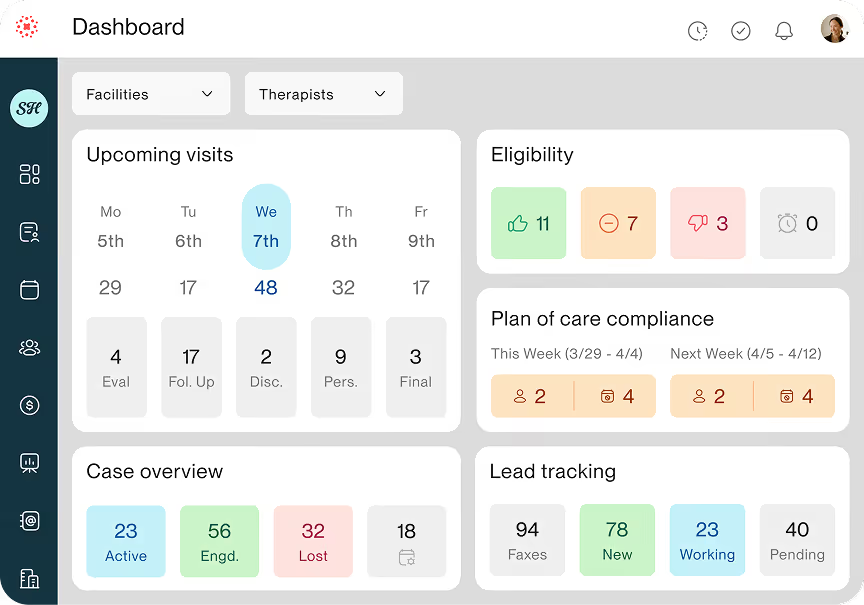
It's difficult to make informed, data-driven decisions as an owner or manager if you lack visibility into the metrics that actually matter for your business. Connecting the data dots shouldn't take extensive effort or involve guesswork, and the best practice is to rely on real-time analytics rather than outdated spreadsheets.
How Prompt helps
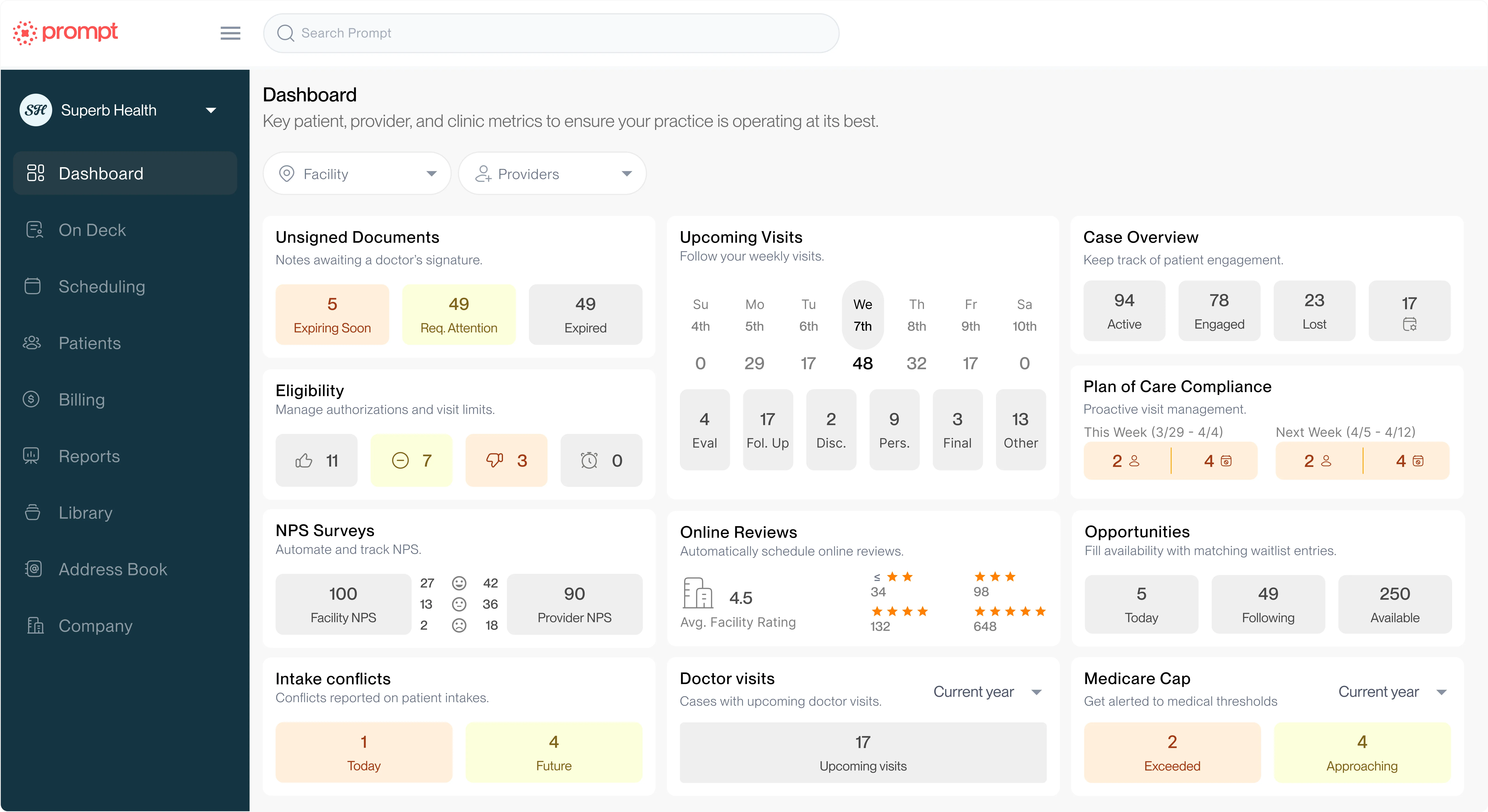
The financial experts who built Prompt worked to make sure you have real-time, trustworthy data in clicks, not cobbled-together Excel reports. You'll have a firmer grasp on practice health and it will be easier to prioritize decisions that have a direct impact on business growth and clinical evidence-based outcomes.
This is achieved via a collection of reports. Learn more about Prompt’s reporting capabilities here:
- “As the owner and CEO, my favorite tools are the Dashboard and Reports that give me an incredible birds eye view of the business. With access to all of my company’s data in real-time, I am able to focus my efforts on the areas that need the most attention day-to-day or week-to-week,” said Amanda Brewer, owner and CEO, Brewer Physical Therapy.
- “With our old systems, we could never really trust the reports because you’d run them multiple times and get different results or they just wouldn’t be working. We never have that problem with Prompt and the real-time reports help us evaluate our business and track KPIs to be proactive about managing our business,” Chris Campbell, founder, Sport & Spine Physical Therapy.
Frequently Asked Questions
What are the biggest benefits of switching PT software?
The five most meaningful benefits that practices report after switching to Prompt are better patient outcomes, less therapist burnout, reduced staffing challenges, increased margins, and the ability to manage objectively with real-time data and analytics. According to Prompt's customer survey, 89% of owners report increased revenue per visit and 91% say their practice is more efficient since making the switch to the Prompt platform.
How does Prompt reduce therapist burnout?
Prompt reduces burnout primarily by cutting clinical documentation time in half for many practices. According to the Reclaim Physical Therapy case study, the practice reported a 50% decrease in documentation time after moving to Prompt, which means therapists can finish their notes before leaving the clinic instead of documenting at home. According to a 2023 peer-reviewed study in the Journal of Educational Evaluation for Health Professions, nearly 50% of physical therapists in the U.S. report experiencing burnout, and the evidence shows that documentation burden is a key modifiable factor identified by the APTA.
Can switching to Prompt actually save money on staffing?
Yes, and the evidence shows the savings can be substantial and independently verified. According to the Achieve Physical Therapy case study, the practice saved over $60,000 per year in labor costs after switching to Prompt. The platform's automated billing, claims processing, and scheduling features reduce the need for front office and billing staff compared to the industry standard. According to the APTA 2024 Workforce Survey, 72% of PTs are at or beyond capacity, which means technology that reduces the staffing burden is increasingly critical for practice sustainability.
How does Prompt help with revenue and margins?
According to Prompt's internal data, the average clinic on the platform grows revenue by $32,000 per provider per year through improved billing efficiency and reduced revenue leakage. Prompt's advanced claims engine and automated billing workflows help practices reduce Days in AR and increase revenue per visit, which directly addresses the margin compression that has been demonstrated across the PT industry. According to the Brewer Physical Therapy case study, the practice reduced their Days in AR from 64 to 17, well below the 30-day industry benchmark established by MD Clarity, and increased their revenue per visit by 12.4%.
Conclusion
There you have it. These five meaningful benefits (better patient outcomes; less therapist burnout; reduced staffing challenges; increased margins; and the ability to manage objectively) are the result of years of developing software that does far more than a standard EMR.
“Since switching to Prompt, we’ve seen an uptick in revenue, a decrease in cost, and have happier employees and patients. For us, Prompt is the only EMR out there doing innovative things and the automation that is offered combined with the Customer Services is second to none. Switching to Prompt has made a huge impact for us and we can’t recommend it highly enough.” — Kathleen Monteiro, Head of Operations, Achieve PT
It’s time to rethink what PT software should be doing for your practice. Learn more about switching to Prompt.




%20copy.png)
.png)


.webp)