What makes PT AI documentation tools actually helpful
Published on
Last updated on
In a 2026 survey of 778 clinicians, satisfaction with AI tools, not simply using one, tracked with less after-hours documentation and stronger career sentiment.
Kelly Brown is a physical therapist. Formerly the VP of Operations at PredictionHealth, she now leads AI development at Prompt through a clinician lens.
Most rehab therapy clinicians already use artificial intelligence (AI) in their work. Far fewer feel it has given them their evenings back. In our 2026 survey of 778 clinicians, the clinicians who reported the least after-hours documentation were the ones who rated their AI tools the highest. The difference wasn't whether they used AI. It was whether the AI was good enough to make a difference in their work. That distinction matters for owners deciding what to buy and for clinicians deciding what to trust with their notes.
Adoption is already widespread
75% of clinicians already use AI in some part of their work. Documentation is where it shows up most: 64% of clinicians use AI specifically for documentation and notes, well ahead of any other use case. Clinical decision support (15%), patient communication (14%), medical coding and billing (17%), and scheduling or admin tasks (12%) all trail far behind. Clinicians reached for AI to solve their single biggest problem first.
Adoption doesn't separate helpful AI from frustrating AI. Satisfaction does.
Among clinicians who use AI for documentation, 82% still chart after hours. Using AI, on its own, didn't lighten the load. What did track with a lighter load was satisfaction with the tool, not simply having one.
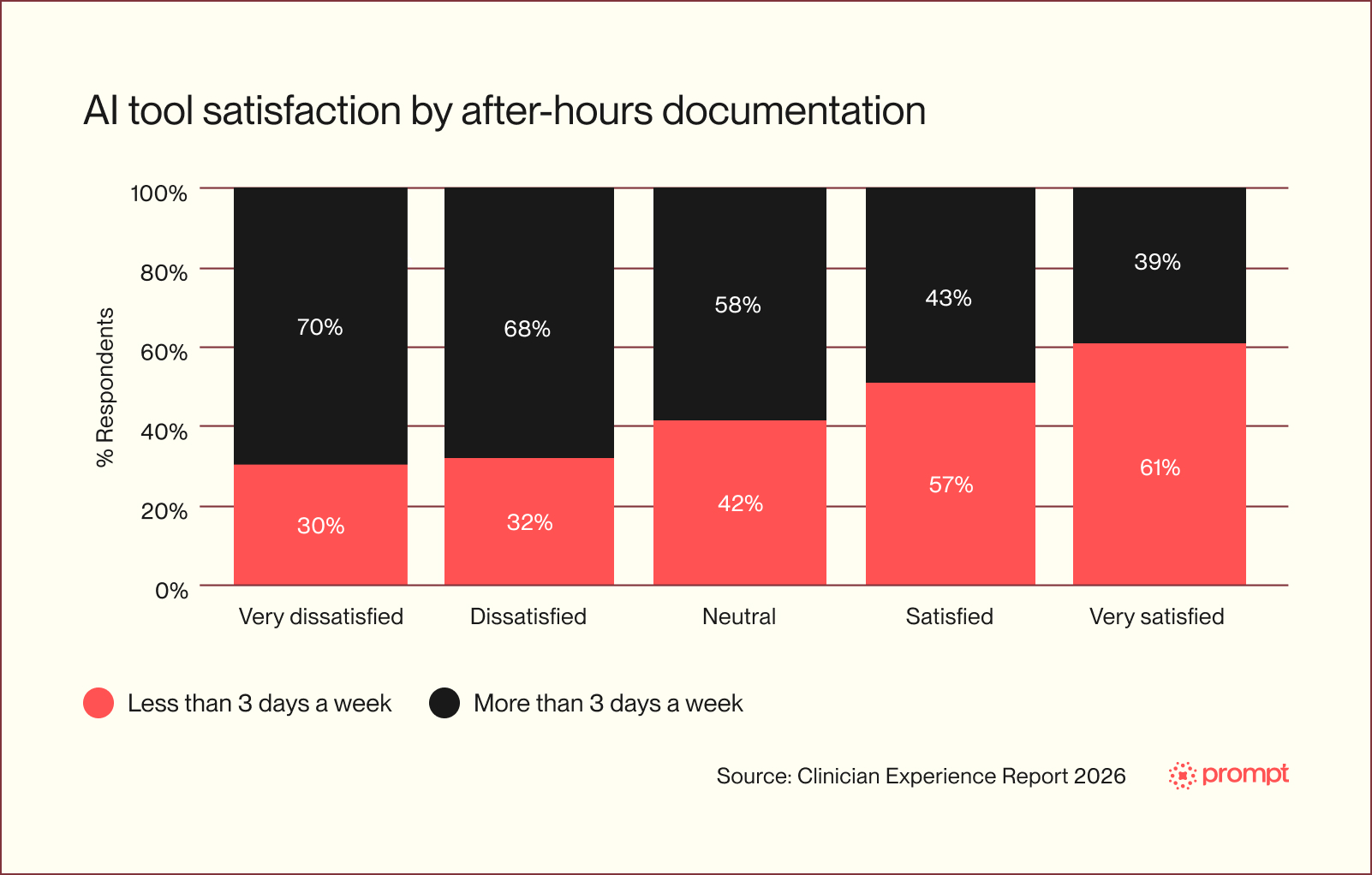
The clinicians most satisfied with their AI tools take documentation home the least. 39% of the most satisfied clinicians chart 3 or more nights a week, compared to 70% of the least satisfied. On the other end, 26% of the most satisfied clinicians never chart after hours, compared to 17% of the least satisfied.
Widen the lens from the extremes to a simpler split, clinicians who rate their AI tools favorably (a 4 or 5 out of 5) versus poorly (a 1 or 2), and the pattern holds up: people who like their AI tool chart 3 or more nights a week 33% of the time, compared to 58% among people who don't like their AI tool.
2 clinicians can use different AI tools for the exact same task can end up with completely different evenings.
Satisfaction, not adoption, is the line that separates them.
What frustrating AI looks like
For some clinicians, AI adds a step instead of removing one. As one clinician described it: "AI tools can make for quicker notes, but only of a lower quality, not including much of what I would if I typed it out, and also takes significant learning curve and effort to say things the right way to get the AI to pick it up and note it." That's the frustrating version: a tool that trades speed for accuracy, or asks for more effort than it saves.
Satisfaction also tracks with how clinicians feel about the career
Clinicians least satisfied with their AI tools were far less likely to recommend the profession, averaging 4.5 out of 10 on that question, versus 7.6 out of 10 among the most satisfied. The most satisfied clinicians were also somewhat more likely to plan to stay in their current role. A tool that's supposed to make the job easier appears to shape how clinicians feel about the job itself.
"I believe the use of AI to help with differential diagnosis and appropriate treatments will greatly help our field."
The practical difference is usefulness, not presence
Adoption gets clinicians in the door. Usefulness is what keeps the tool paying off after that.
These findings are correlational, not causal: satisfied clinicians reported less after-hours work and stronger career sentiment, but the survey doesn't establish that a better AI tool caused either outcome. What it does show is that having AI and having AI clinicians actually value are 2 different things, and one of them shows up in fewer nights spent charting.
For practices evaluating AI tools, that's the practical takeaway.
The question isn't whether clinicians will use it. Most already do. The question is whether the tool holds up once it's part of the daily routine, on real notes, for real patients, without adding a second job of managing the AI itself.
Does using AI reduce after-hours documentation for clinicians?
Not by itself. Among clinicians who use AI for documentation, 82% still chart after hours. What tracked with less after-hours work was satisfaction with the tool, not simply having one.
How many rehab therapy clinicians use AI in their work?
75% of clinicians already use AI in some part of their role. 64% use it specifically for documentation, the most common use case by a wide margin.
Does AI satisfaction affect whether clinicians recommend the profession?
Yes, it's associated with it. Clinicians most satisfied with their AI tools rated their likelihood to recommend the profession far higher on average than clinicians least satisfied with their tools.
What do clinicians use AI for besides documentation?
Medical coding and billing (17%), clinical decision support (15%), patient communication (14%), and scheduling or admin tasks (12%) all see meaningfully less AI use than documentation, which 64% of clinicians already use it for.
Subscribe for updates
Get practice growth tips delivered right to your inbox
Thank you! Your submission has been received!
Oops! Something went wrong while submitting the form.
By submitting your information, you agree to Prompt's Privacy Policy. You can opt out anytime.





.png)

.jpg)